
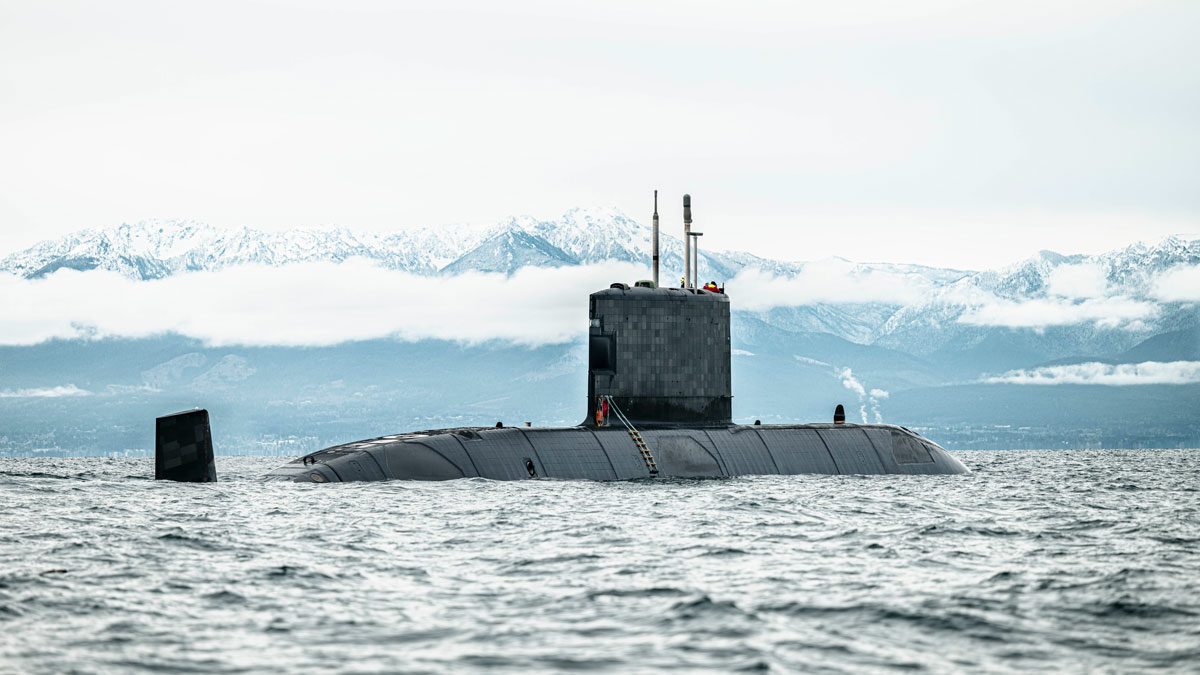

As Canada moves closer to a decision on its next submarine capability, attention is turning to the realities that will determine long-term success: infrastructure, workforce capacity, and industrial readiness.
This was the focus of a fireside chat at November’s Deep Blue Forum 2025. In the discussion, Comdr Keith Coffen (Ret’d) spoke with David Hudock, National Director, Defence & Federal Government Relations, PCL Construction and Comdr Darcy Byrtus RCN (Ret’d) on what it will take to deliver and sustain Canada’s future submarine program. Drawing on lessons from the National Shipbuilding Strategy, major infrastructure delivery, and past defence initiatives, they examine the scale of construction required, the pressure on skilled trades, the role of industry in training and technology transfer, and the importance of long-term government commitment.
Group Inc.


Keith Coffen
Q: Thanks for joining us here today. To start the conversation: If there’s one theme to take away from what we’ve heard at Deep Blue so far, it’s that we can do a lot of harm by concentrating only on the acquisition of submarines. We don’t need to look far to understand why that is. We have Victoria class submarines in service, only one of which can go to sea. And our average availability from those submarines is not high. So, the submarine we choose is probably less important than making sure that we get the sustainment piece right. I want to explore this further.
Dave I’ll start with you for your thoughts.
David Hudock:
Thanks, Keith. Before I begin, I want to acknowledge that there is a silent service in the room here with us today, and it’s not submariners. It is members of the industry that I’m in right now. The builders, the architects, and the engineers. Three years ago, I don’t think there were any builders at Deep Blue except for me. And now there’s a whole bunch. Thanks to all of you builders for your interest.
It’s important for Canada that the construction industry has an awareness of the important stuff we’re talking about here. We’re talking potentially about $100 billion in construction projects over the next 15 years. That’s in addition to a growing list of other nation-building projects that Canada wants to get moving on and piling more work on an already extremely busy industry.
I want to make sure that the people in this room thinking about submarines, thinking about capability, and thinking about technology also understand that there’s a whole other nuts and bolts and concrete and steel element that’s going to have to be developed. That includes construction of new facilities, support for training, and support of the maintenance. That takes time.
It’s important to provide a little bit of background and information on all that we’ve been talking about at Deep Blue, and in the context of the submarines that will arrive by 2035. In the world of construction and design, that’s not a long time.
We’re probably already behind the eight ball. By 2032, 250,000 retirements are expected in the construction industry. And I guarantee you that right now we are not seeing a one-for-one replacement of new people. One of the ways the construction industry is responding is by leveraging technology and innovation—not to replace workers, but to extend the capacity and productivity of the workforce that remains, enabling more to be built with the people available. The second point is cost escalation. Ten years ago, the average cost of constructing hospitals across Canada was around $1,000 a square foot. Today, that average cost across Canada is just over double that. Cost escalation is something that we all have to be thinking about, especially if there’s going to be a significant time lag between today and when the shovel goes in ground. Project cost escalations hit a peak during COVID-19, but costs for building materials and other associated elements, including labour, continue to have annual increases, and at rates much higher than we saw pre-COVID.
Another point is that there is just more construction activity on the books. Markets in certain regions of the country are flooded with work. And builders and designers are picking and choosing what they want to go for. They don’t want to pick the wrong project and risk getting tied down to a high risk, low profit contract. They always think better ones are coming.
We’ve seen a pattern since the beginning of COVID. Private developers and investors have been putting their main projects on hold because they were too expensive. But guess what? With interest rates declining they have dusted off those plans. They’ve been contacting us to say they’re getting ready to build that office tower, that condo, that commercial facility.
Another critical consideration is the delivery model used to engage designers, architects, and engineers. Traditional approaches—where design teams work for several years before projects are tendered to construction—create long timelines and often result in higher levels of change orders. An alternative is a design-build model, where builders are engaged early with integrated design teams, operating as a single, coordinated unit. Then there are public private partnerships. PCL is an active partner in many of them. But these partnership deliveries, in the construction world, take a long time to go from beginning up to the point where you’re ready to put shovels in ground.
These are things I thought people in the room today should be aware of and should bring into your thinking for the submarine program. It’s important to consider how quickly you want things, how much risk are you willing to take, and so on.
Keith Coffen
Q: Thanks Dave, you’ve laid out the scale, timing, and workforce realities we’re facing. Darcy, from your perspective, what role does industry need to play—starting now—to ensure the infrastructure, sustainment, and delivery model are ready to support the new submarine capability? And what is the industry’s role in the transformation of the new submarine?
Darcy Byrtus
Our role has become especially prominent. But there will have to be collaboration across all parts of the enterprise. What I see is we talk about infrastructure, we talk about in-service support, and we talk about workplace training. All of these things not only have to get done, but they have to get done at the same time. There’s little point in having training facilities, workshops, and lift facilities in place and ready to go if there aren’t the people there to operate and manage them.
As Dave pointed out, infrastructure is likely to be the long pole here—most major infrastructure programs take 15 years or more to execute. So, as we’ve heard today, especially given the lessons we’ve learn from the National Shipbuilding Strategy, in certain areas industry has done a good job of showing it can be done. We see this in the work Seaspan, Stantec and Babcock are doing. And, of course, we’ll be getting valuable lessons from the submarine supplier.
So, this is going to have to be a lot more collaborative than I think we are collectively used to in these types of programs. And it’s going to be impacted by the type of in-service support contract that gets executed. It’s going to involve transferring those technologies and expertise. It’s going to involve updating the current staff across uniformed public service, industry staff, and ensure those supply chains and all the systems are in place, so we don’t repeat legacy issues.
Earlier this morning we talked about the Royal Canadian Navy’s capability and training challenges, and how industry can support the Navy as it scales. That task becomes even more complex when you consider we’re tripling the fleet and introducing much more advanced technology. There’s going to be new materials and requirement. There’s going to be new sensor technologies, new noise-canceling technologies, hydrodynamic ice and so on. I was in the original nuclear program way back when we were buying nuclear. We had a lot of studies about ice at the time, and it was kind of déjà vu for me when I heard the panel earlier today discussing all the things we have to consider around Arctic activities.
There are a lot of considerations here. One of the big things is that this whole enterprise is going to require a concerted, consistent, and long-term commitment by the government to ensure we deliver. It means sticking to a clear, long-term strategic plan so industry—large, medium, and small companies alike—have the confidence that investing today will deliver returns over time and not be abandoned in four or five years.
That level of commitment from government is going to be critical to the sustainment of all the elements of this industry. One point raised today that bears reinforcing is the need for industry to adapt to new regulatory and material certification requirements for the future submarine fleet. This will require meeting environmental standards both domestically and under a certification regime that will differ from that of the parent submarine.
That’s the kind of expertise that hasn’t been mentioned much today. I want to remind everyone that it’s something we’ll have to get up to speed on because these submarines are going to be deployed globally with NATO and our Asia-Pacific partners. We’re going to have to make sure that we are capable of doing that.
Keith Coffen
Q: Given the scale of what you’ve outlined—new infrastructure, new technologies, new regulatory requirements, and a fleet that is both larger and more complex—how realistic is it for the shipbuilding, repair, refit, and maintenance industries to meet the demand for skilled trades by 2030? And in parallel, how does the Navy prepare its own workforce to keep pace?
Darcy Byrtus
It’s going to be an enormous challenge. It will require deep partnerships across industry and the STEM ecosystem, and significant early investment by the Department of National Defence in people. Just as importantly, there needs to be a structure that can adapt as technology evolves—because, as we’ve heard today, capability sustainment will be continuous, not a one-time effort.
This isn’t going to be a static, technology that stays still. Investments with academic institutions, research institutions, innovation programs, and so on to adopt a lot of that and keep the people going and updated will be critical.
In the near term, this will require deep collaboration with the submarine builder. Builder expertise needs to be embedded early in the development of in-service support and maintenance programs—and Canadian personnel embedded alongside them. This isn’t just about re-skilling existing shipyard and Navy staff; it’s about building an entirely new level of capability to support a fleet that is three times larger. We’re probably looking on the order of 1,200 submariners instead of 350.
So it is that is probably the biggest challenge because you can build all the buildings you want. You can have all the processes in place, but if there’s no people there to execute them, then we will face serious challenges.
