
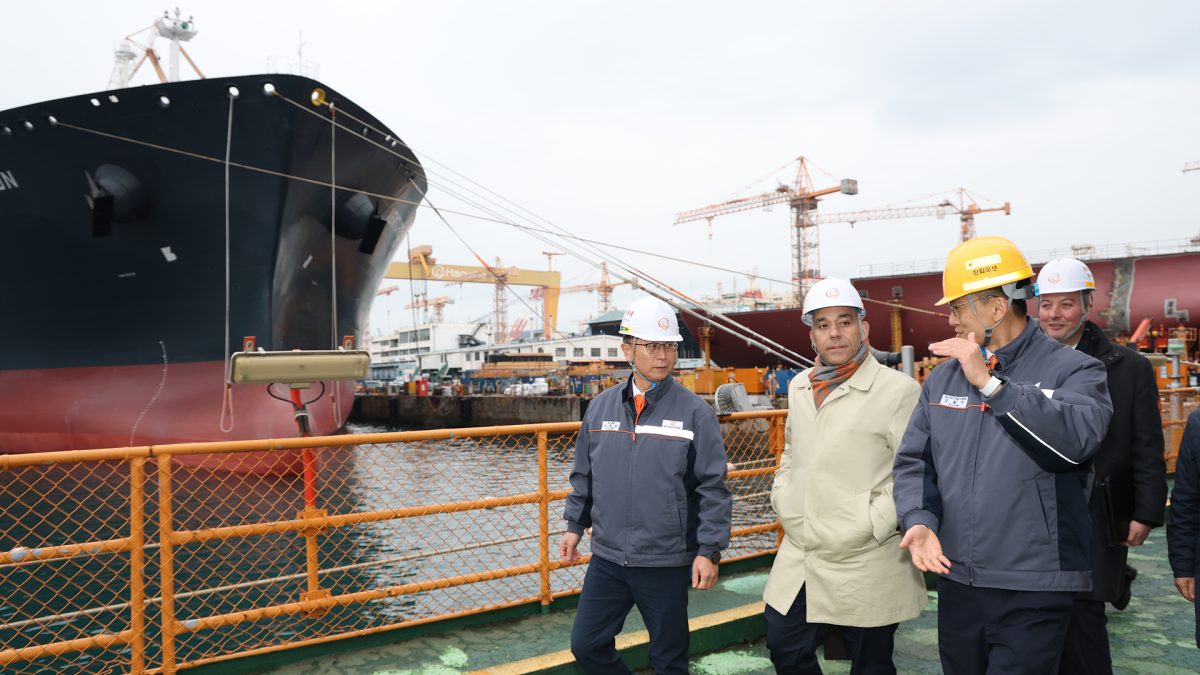

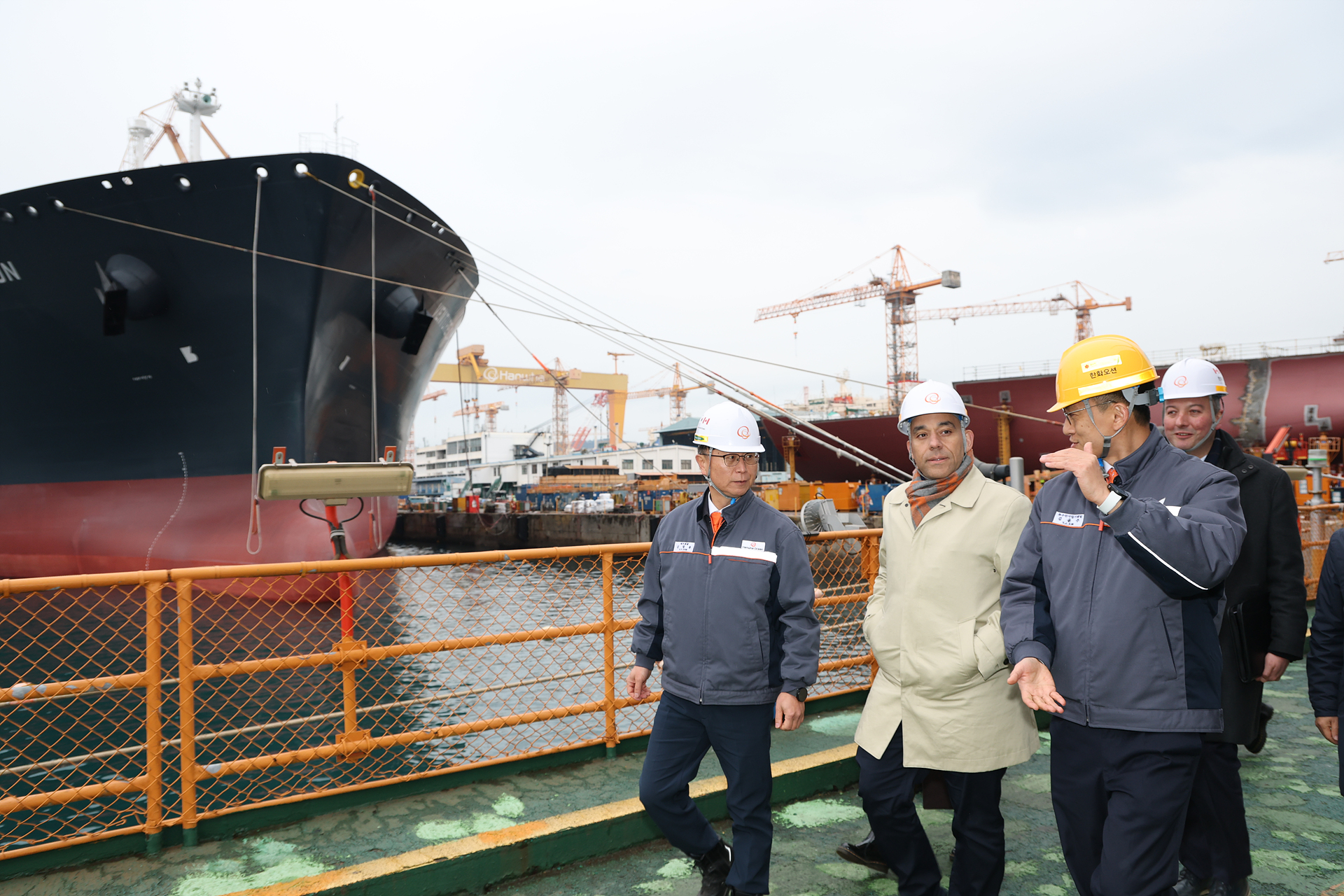
On February 11, 2026, Quebec’s international ambitions met one of the world’s most advanced shipbuilding operations when the Honourable Christopher Skeete, Quebec’s Minister of International Relations, visited Hanwha Ocean’s flagship shipyard in Geoje, South Korea.
The visit was more than ceremonial. It was a focused exploration of how Quebec’s marine and defence ecosystem could be linked to Canada’s future under the Canadian Patrol Submarine Project (CPSP). As Canada evaluates pathways for renewing its submarine capability, the discussions in Geoje centered squarely on industrial participation, workforce integration, and long-term sustainment—core pillars of any credible national shipbuilding enterprise.
Inside the KSS-III Production Line
At the heart of the visit was a detailed tour of Hanwha Ocean’s sprawling, highly automated shipyard. Minister Skeete and the Quebec delegation observed active production lines for the KSS-III submarine—the exact in-service and in-production platform Hanwha Ocean is proposing for the CPSP.
Robotic welding systems moved with precision along hull sections. Smart-yard technologies synchronized workflows across the facility. An augmented-reality-enabled painting demonstration offered a glimpse into how advanced digital tools are reshaping naval manufacturing.
The delegation also boarded and toured the KSS-III submarine launched for the Republic of Korea Navy in October 2025. From exterior design to interior systems, the visit provided firsthand exposure to the platform’s construction process and operational configuration. Hanwha Ocean emphasized its mature production environment and accelerated delivery capacity, highlighting its ability to deliver complex naval platforms on budget and on schedule.
Building Quebec into the Industrial Framework
The Geoje visit followed recent engagements and Memoranda of Understanding between Hanwha Ocean and Quebec-based organizations. These include a MOU with MDA Space for satellite communications and defence space cooperation, and a MOU with Montréal International focused on advanced manufacturing collaboration.
Together, these agreements reflect Hanwha Ocean’s broader approach to distributing long-term industrial benefits across Canada. In Quebec’s case, that means aligning CPSP participation with the province’s established strengths in aerospace, space technologies, advanced manufacturing, and marine industries.
Discussions during the visit explored how Quebec’s shipbuilding and defence industrial base could be integrated into Hanwha Ocean’s CPSP framework. Key themes included workforce integration, equipment localization, sustainment activities, and supply-chain participation.
Particular attention was given to the Lévis region’s marine cluster, home to Davie Shipbuilding—one of Canada’s major shipyards. Leveraging this regional expertise could form part of a long-term sustainment and maintenance ecosystem under CPSP, ensuring that industrial capability and skilled employment are anchored in Quebec.
A Broader Canadian Engagement
Minister Skeete’s visit forms part of a series of official Canadian tours to Hanwha Ocean facilities. Previous delegations included the Honourable Victor Fedeli, Ontario’s Minister of Economic Development, and the Honourable Stephen Fuhr, Canada’s Secretary of State for Defence Procurement.
Together, these visits underscore the national scale of the CPSP conversation. While the submarines themselves are central, the larger question is how Canada builds, sustains, and evolves a domestic industrial ecosystem capable of supporting them over decades.
Hanwha Ocean has positioned its proposal not simply as a platform offering, but as a long-term partnership aligned with domestic economic priorities.
As In-Sub Jung, President and Head of Management Support Office at Hanwha Ocean, stated:
“Hanwha Ocean is committed to being a trusted partner that actively supports the ‘Buy Canadian’ policy in Quebec and across Canada. Our aim is to support local investment and job creation, while building long-term workforce capability through skills transfer and advanced technologies.”
For Quebec, the Geoje visit provided tangible insight into how localization, technology transfer, and supply-chain participation could translate into economic and industrial benefits. For Hanwha Ocean, it was another step in demonstrating how its industrial model could align with Canadian—and specifically Quebec—priorities.
As Canada moves forward with the CPSP, the conversation is clearly not confined to shipyards alone. It spans provinces, clusters, and capability pipelines—linking advanced manufacturing in Quebec to submarine production lines in Korea, and potentially back again in the decades to come.
