

A new chapter in Canada’s defence-industrial landscape is taking shape, as the Automotive Parts Manufacturers’ Association (APMA) and Hanwha Corporation move to establish a Canadian-based joint venture aimed at producing military and non-commercial industrial vehicles at scale.
Announced on April 29, 2026, in Toronto, the partnership is positioned to create a fully domestic production capability—one that leverages Canadian labour, materials, and industrial know-how to deliver both heavy military platforms and specialized industrial vehicles for use at home and abroad.
At its core, the venture is designed to be unmistakably Canadian. Vehicles produced under the new entity will be manufactured domestically using Canadian steel and aluminum, with Canadian workers at the centre of operations. The structure reinforces national control, with Canadian majority ownership, a Canadian-led board, and a Canadian CEO guiding the enterprise.
The initiative aligns directly with the “Build in Canada” pillar of the federal government’s Defence Industrial Strategy (DIS), aiming to strengthen sovereign production capacity while expanding the share of defence procurement directed to Canadian industry. It also carries significant economic implications, with the potential to protect and create tens of thousands of jobs across the country’s automotive sector.
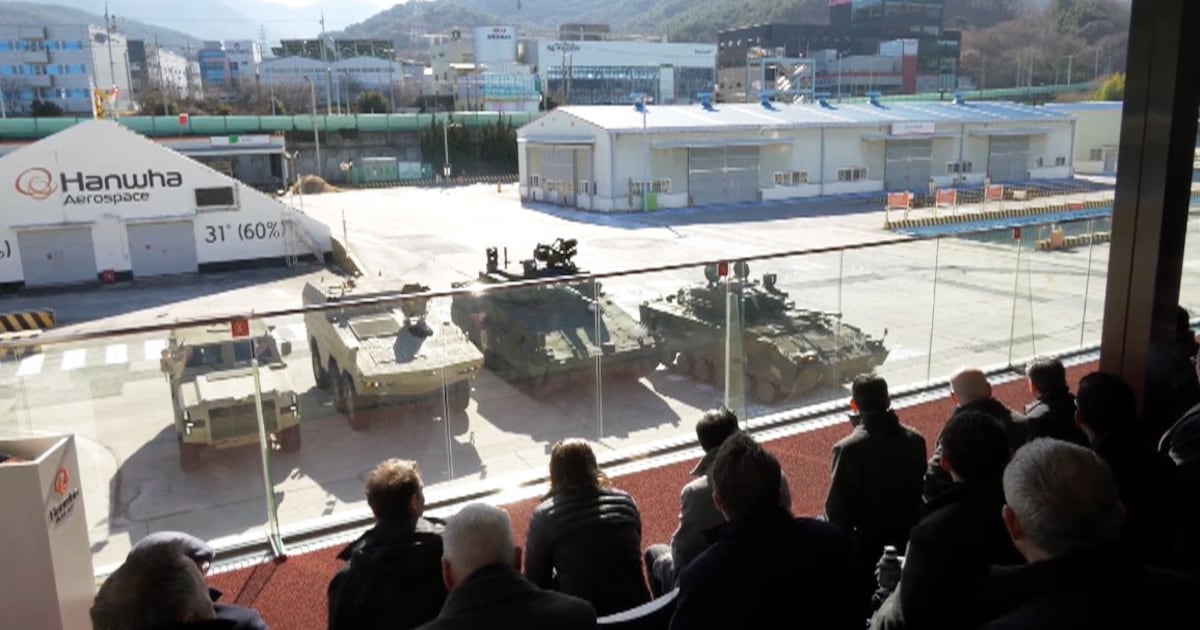
However, the full realization of the venture hinges on a critical procurement decision: the selection of Hanwha’s KSS-III submarine for the Canadian Patrol Submarine Project (CPSP). Should that bid succeed, the partnership will expand to include domestic production of a suite of advanced military platforms, including the K9 Thunder self-propelled howitzer and K10 ammunition resupply vehicle, the Redback infantry fighting vehicle, the Chunmoo multiple launch rocket system, and a range of uncrewed ground vehicles.
Beyond military applications, the joint venture is set to establish a dedicated Canadian automotive business unit focused on non-commercial industrial vehicles. These platforms are intended to support a wide array of end users—from the Canadian Armed Forces and all levels of government to emergency services and Arctic and resource-sector operations—while also positioning Canada as an exporter to allied markets.
“This joint venture will deliver on the Prime Minister’s challenge to Canada’s automotive sector to help drive the country’s unprecedented commitment to national defence. This partnership, should Hanwha’s KSS-III submarine be selected for the Canadian Patrol Submarine Project, will be tremendous for Canada’s automotive sector. The APMA is proud to extend our full support to South Korea’s bid and broader industrial opportunities it presents for Canada,” said Flavio Volpe, President, Automotive Parts Manufacturers’ Association.
The partnership reflects a broader shift toward integrating Canada’s industrial base with global defence supply chains while retaining sovereign control over production and sustainment.
“Canada brings world-class advanced manufacturing and highly skilled talent pools and APMA has long stood at the center of Canada’s manufacturing leadership and innovation. We believe that when Canada’s industrial capability is combined with Hanwha’s technology and manufacturing experience, we could accomplish a new model of cooperation that goes beyond mere procurements,” expressed Son Jae-il, CEO, Hanwha Aerospace.
For Hanwha, the agreement signals more than a market entry—it represents a long-term industrial commitment tied to Canada’s evolving defence posture.
“Today’s agreement is a historic commitment to shaping the future of Canada’s defence industry together. Perfectly aligned with the Government of Canada’s ‘Build in Canada’ principle and Defence Industrial Strategy (DIS), this is more than a submarine contract — it is Hanwha’s promise to strengthen Canada’s industrial capacity and economic sovereignty,” stated Steve SK Jeong, SEVP, Head of Naval Ship International Business, Hanwha Ocean.
If realized, the venture could mark a significant inflection point—linking Canada’s automotive manufacturing strength with next-generation defence production, while embedding sovereign capability at the heart of future procurement and export strategies.
