
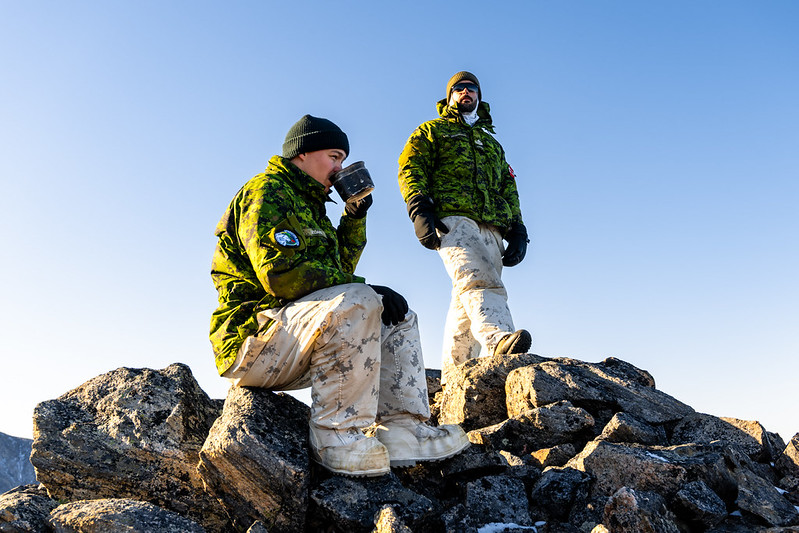

As climate change accelerates access to the world’s northernmost waters and heightens geopolitical interest in the region, the Canadian Armed Forces (CAF) have been steadily expanding their operational footprint across the Arctic. This summer and fall, that footprint grew larger and more capable than ever.
From long-range patrols on Ellesmere Island to a historic northern milestone for a Royal Canadian Navy (RCN) ship, the CAF delivered a season of tightly coordinated, high-tempo operations that strengthened domain awareness, sharpened interoperability with allies, and demonstrated Canada’s readiness to detect, deter, and defend across one of the world’s most strategically important regions.
“Asserting sovereignty in the Canadian Arctic is becoming more important than ever as our adversaries increase their activity in the region. These northern operations continue to create excellent opportunities for strengthened collaboration with our allies and partners. Defending Canada’s North alongside our allies is critical to maintaining a secure North America,” expressed the Honourable David J. McGuinty, Minister of National Defence.
A Season Defined by Partnership and Reach
Working alongside the Canadian Coast Guard, the Northern Interdepartmental Information Partner Network, the U.S. military, and NATO allies, CAF ships, aircraft, and personnel deployed across the Arctic approaches in a series of missions designed to reinforce continental security. This whole-of-government and multinational approach enabled deeper information sharing and brought new operational efficiencies to an environment where collaboration is not just an advantage—it’s a necessity.
“The Canadian Armed Forces’ persistent presence in the Canadian Arctic strengthens domain awareness in the North and its surrounding areas, enhancing our ability to detect, deter and defend against emerging threats in this evolving environment. These operations demonstrate our enduring commitment to defending Canada, asserting our sovereignty, and contributing to a secure North America,” said General Jennie Carignan, Chief of the Defence Staff.
Pushing Northward Under Operation NANOOK-TAKUNIQ
The season began in July with the Canadian Rangers and soldiers from 2nd Battalion, Princess Patricia’s Canadian Light Infantry advancing through Ellesmere Island on foot, by ATV, and aboard CC-138 Twin Otter aircraft. These long-range reconnaissance patrols, part of Operation NANOOK-TAKUNIQ, provided crucial insight into terrain, infrastructure, and logistics routes across Canada’s High Arctic.
Supported by the Royal Canadian Air Force’s (RCAF) 440 Transport Squadron and the Airfield Surface Assessment and Reconnaissance team, the patrols validated operational capabilities while feeding directly into future plans for security and sovereignty activities in the region.
“The Canadian Armed Forces maintains a permanent Northern presence and is expanding its ability to project forces to conduct and sustain near-persistent Arctic operations. I am proud of the work our sailors, soldiers, aviators and rangers, along with joint and interagency partners and Indigenous communities achieved these past months. These efforts, along with those involving our allies and partners, assert our sovereignty and contribute to the defence of Canada and North America in this vital region,” expressed Lieutenant-General Steve Boivin, Commander Canadian Joint Operations Command.
Operation LATITUDE: Strengthening Maritime Awareness
In August and September, the CAF shifted from land to sea under Operation LATITUDE—an ambitious, binational operation conducted with U.S. forces across the Northern Pacific and Western Arctic.
HMCS Regina, HMCS Max Bernays, MV Asterix, His Majesty’s Canadian Submarine Corner Brook, and a CP-140 Aurora aircraft formed the backbone of Canada’s contribution.
The operation marked several major achievements:
- HMCS Regina integrated seamlessly with RCAF, U.S. Navy, U.S. Coast Guard, and U.S. Air Force assets—including during a joint combined strike demonstration with USAF F-35 aircraft.
- MV Asterix showcased its replenishment-at-sea capabilities, extending the endurance of multiple ships operating far from port.
- HMCS Max Bernays sailed north through the Bering and Chukchi seas, reaching 81° North on August 29—setting the record for the most northern point ever achieved by an RCN vessel.
- The CP-140 Aurora enhanced maritime domain awareness across vast distances, including monitoring the dual-purpose vessel Xue Long 2 as it operated in international waters off North America’s coast.
Operation NANOOK-NUNAKPUT: Protecting the Northwest Passage
While LATITUDE unfolded in the Western Arctic, CAF personnel from the Canadian Army, RCN, and RCAF conducted layered land, air, and maritime patrols along the Northwest Passage under Operation NANOOK-NUNAKPUT.
Exercises and engagements included:
- a vessel-of-interest interdiction
- an emergency spill response with the Canadian Coast Guard
- on-the-ground interaction with local and Indigenous communities in Iqaluit and Pond Inlet
These activities strengthened both situational awareness and community partnerships—cornerstones of effective northern security.
HMCS William Hall Charts a Multi-Mission Path
From August to October, HMCS William Hall moved through the Northwest Passage as part of Operation NANOOK-TUUGAALIK, supporting both NUNAKPUT and multinational maritime activities.
Before reaching the High Arctic, the ship conducted operations with the French, German, and Danish navies in the Labrador Sea—reinforcing the CAF’s ability to integrate with allied fleets before navigating one of the most challenging waterways on Earth.
Operation NANOOK-TATIGIIT: Preparing for Northern Emergencies
The season concluded in late October with Yellowknife’s regional task force headquarters wrapping up Operation NANOOK-TATIGIIT, a major whole-of-government disaster rehearsal exercise. Bringing together domestic and international partners, the exercise strengthened readiness for security incidents and emergencies in the Arctic—where distance, weather, and limited infrastructure demand advanced planning at every stage.
