
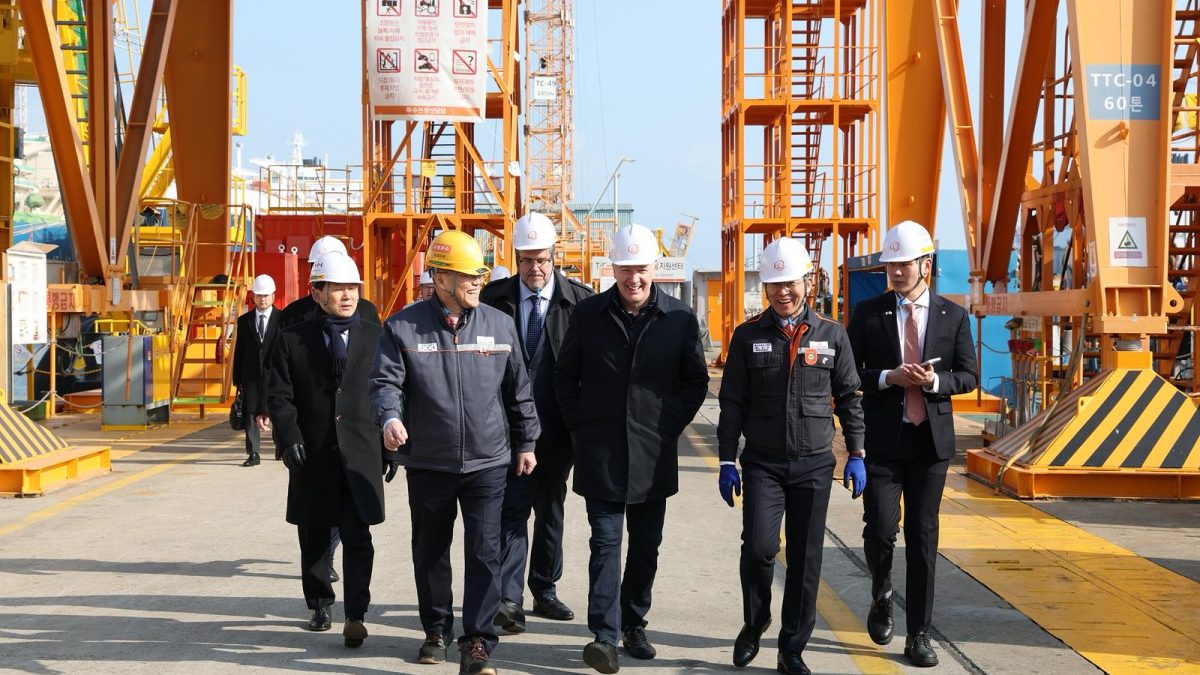

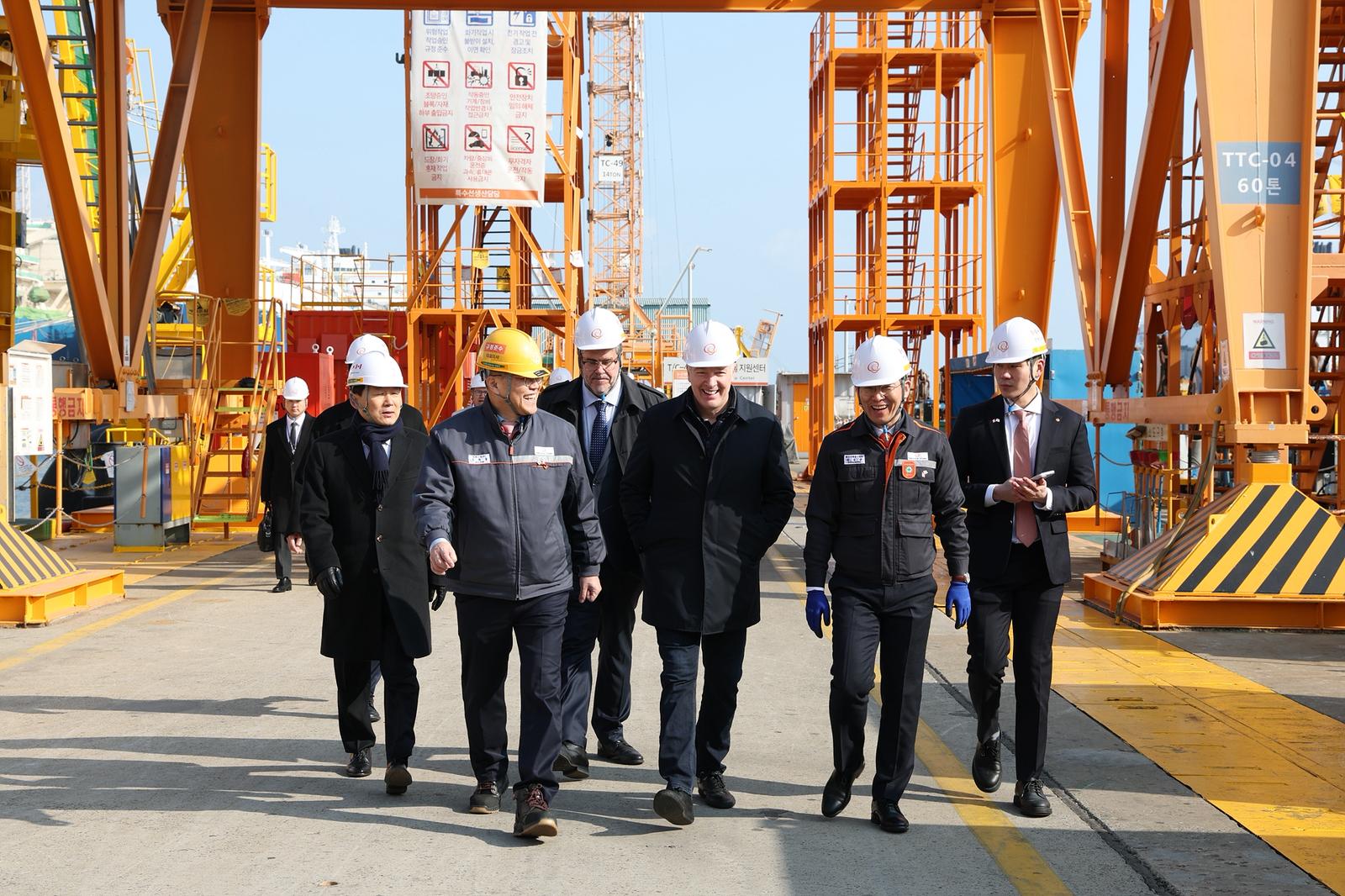
On the southern coast of South Korea, amid towering gantry cranes and fully automated production lines, a powerful signal of Canada’s future undersea ambitions took tangible form. The Honourable Stephen Fuhr, Canada’s Secretary of State for Defence Procurement, arrived at the Geoje shipyard of Hanwha Ocean with a delegation representing more than 20 Canadian companies—an industrial cross-section that reflects the scale and urgency of Canada’s Canadian Patrol Submarine Project (CPSP).
The visit placed Canada’s submarine modernization squarely in the context of proven capability, accelerated delivery, and deep industrial partnership.
A Front-Row View of a Proven Submarine Program
At Geoje—one of the largest and most advanced shipbuilding facilities in the world—Secretary of State Fuhr and the Canadian delegation toured the active, highly automated production line for the KSS-III submarine. The delegation boarded and explored a completed, in-the-water KSS-III submarine launched for the Republic of Korea Navy in October 2025—the exact proven, in-service, and in-production platform that Hanwha Ocean is proposing for Canada.
For Canadian officials and industry leaders alike, the experience provided something rarely available during major defence procurements: direct exposure to a submarine already operating at sea, backed by an industrial base delivering at tempo.
Hanwha Ocean used the visit to highlight the KSS-III’s ability to meet and exceed CPSP requirements, including superior underwater surveillance, extended range and endurance, and deployability in Arctic conditions—capabilities designed to provide stealth and persistence across all three of Canada’s oceans.
Building Trust Through Operational Reality
The delegation also travelled to the Republic of Korea Navy Submarine Force Command base, where they met senior submarine leadership, toured an in-service KSS-III submarine, and visited both the submarine training centre and the maintenance, repair, and overhaul facility.
It is here that Royal Canadian Navy sailors would train alongside Korean counterparts while Canada’s submarines are under construction—and where Canadian submarines could receive maintenance and support when deployed in the Indo-Pacific.
Admiral Kang Dong-gil, Chief of Naval Operations of the Republic of Korea Navy, underscored the depth of the bilateral relationship and Korea’s commitment to Canada’s urgent modernization needs:
“The people of the Republic of Korea hold deep gratitude toward Canada, which demonstrated its commitment by deploying the third-largest contingent during the Korean War. Republic of Korea submarines, whose performance has already been recognized in the global market, have been thoroughly validated across diverse undersea environments, enabling them to conduct flawless operations even in Canada’s extreme cold and Arctic conditions. To address Canada’s urgent force-modernization needs, the Republic of Korea Navy will ensure strict adherence to delivery schedules through rapid and precise construction, and will continue to provide comprehensive post-delivery logistics support—including crew training and the sharing of maintenance infrastructure—to sustain the strong trust between our two nations.”
The Lowest-Risk, Fastest Path to a 12-Boat Fleet
Hanwha Ocean presented a delivery approach unmatched by any competing option. If on contract in 2026, four KSS-III submarines could be delivered before 2035—fully replacing Canada’s current Victoria Class fleet. Earlier retirement of the Victoria Class would generate estimated savings of approximately $1 billion in maintenance and support costs.
The remaining eight submarines would be delivered at a steady rate of one per year, enabling Canada to field a full fleet of 12 submarines by 2043. No other option comes close to this schedule.
Equally significant, Hanwha’s accelerated timeline means that Canadian job creation and industrial activity would begin immediately upon contract award—rather than years later.
Hee Cheul Kim, CEO of Hanwha Ocean, framed the proposal as both industrial and strategic:
“Hanwha will serve as a coordinating and driving force to ensure that support from the Government of the Republic of Korea is closely aligned with corporate-level efforts, thereby providing tangible support for Canada’s defence autonomy. Hanwha Ocean and the Hanwha Group are committed to being a trusted industry partner for Canada.”
Charlie SC Eoh, President of Naval Ship Business at Hanwha Ocean, added:
“It was a great pleasure to host Secretary of State Fuhr at our shipyard today and show him the proven, in-service and in-production KSS-III submarine that we feel is the best submarine for the Canadian Patrol Submarine Project. Equally important was our discussion on the economic benefits we plan to bring to Canada as part of this project as well as how Canada and South Korea can enhance their relationship in a number of areas that are of strategic importance to both nations.”
A Pan-Canadian Industrial Coalition
The visiting delegation included a broad range of Canadian companies such as Algoma Steel, MDA Space, Telesat, Ontario Shipyards, Irving Shipbuilding, Seaspan Shipyards, Davie, Babcock Canada, CAE, and L3 Harris Canada—a reflection of the industrial depth Hanwha intends to mobilize across Canada.
Rajat Marwah, CEO of Algoma Steel, emphasized the importance of domestic materials and manufacturing:
“Algoma Steel is proud to have accompanied Secretary of State Fuhr on this important visit to the Hanwha shipyard in Geoje, South Korea. Our strategic arrangement with Hanwha Ocean is a foundational step in Algoma’s diversification strategy. Algoma is focused on becoming Canada’s leading sustainable steelmaker and a key supplier for defence priorities, including the Canadian Patrol Submarine Project. We applaud the Government of Canada’s support for policies that strengthen domestic manufacturing to build Canada Strong.”
Jean-François Séguin, Vice President of Communications and Government Relations at Irving Shipbuilding, noted the importance of applying lessons learned:
“Irving Shipbuilding and Fleetway are pleased to be participating in the Canadian trade delegation visit to Korea, led by the Secretary of State for Defence Procurement, the Honourable Shephen Fuhr. This visit provides an opportunity to understand our role in maximizing the success of the Canadian Patrol Submarine Program. We believe our learnings and achievements under the National Shipbuilding Strategy should be leveraged as Canada acquires and sustains a new combatant submarine fleet.”
Ted Kirkpatrick, Vice-President of Business Development and Government Relations at Ontario Shipyards, highlighted sovereign capability:
“Ontario Shipyards is proud to join Secretary of State Fuhr and the Canadian delegation as we deepen industrial cooperation that can deliver real capability and jobs at home in Canada. Building sovereign defence capability means having a robust Canadian shipbuilding industry capable of efficient construction and sustainment. We’re excited to explore how our facilities and workforce can leverage the impressive shipbuilding experience and capability on display at Hanwha’s Geoje Shipyard.”
Beyond Submarines: A Generational Economic Opportunity
Hanwha framed CPSP as a catalyst for broader Canada–Korea industrial cooperation spanning shipbuilding, defence, space, aerospace, sustainable energy, critical minerals, advanced manufacturing, and leading-edge technologies.
An analysis by KPMG forecasts that Hanwha’s CPSP-related investments would support more than 200,000 person-years of employment across Canada between 2026 and 2040—equating to roughly 15,000 jobs annually.
Recently announced cooperation includes:
- Steel Investment: $345 million in Algoma Steel facilities to procure made-in-Canada steel and improve domestic production capabilities.
- AI & Smart Systems: Multilateral MOUs with Cohere and Hanwha Systems, plus investment in PV Labs for advanced targeting systems with export potential.
- Space Systems: Partnerships with MDA Space and Telesat on advanced satellite technologies and next-generation sovereign connectivity solutions.
- Sovereign Sustainment: Partnerships with Babcock Canada, PCL Construction, and CAE to ensure readiness and a low-risk transition.
Together, the Geoje visit underscored a central message: Canada’s submarine future is no longer theoretical. It is visible, in production, and backed by an industrial alliance ready to move at speed—bringing with it sovereignty, capability, and generational economic impact.
