

Shipbuilding—long defined by precision, complexity, and painstaking coordination—is entering a new phase. At its heart is a shift from manual, document-heavy processes to digitally enabled engineering, where artificial intelligence begins to shape not just how ships are built, but how they are conceived.
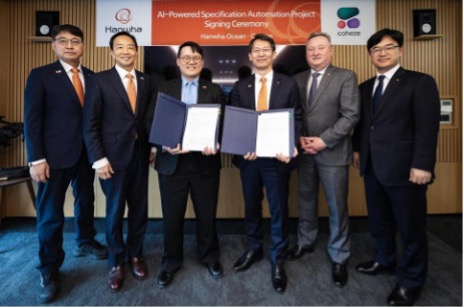
That transition is now taking tangible form through a new proof-of-concept project between Cohere and Hanwha Ocean. Announced following a March 31 agreement signed in Seoul, the initiative is focused on integrating generative AI directly into engineering workflows—specifically targeting the creation and validation of Purchase Order Specification (POS) documents, the foundational blueprints that guide ship design, procurement, and system integration.
Traditionally, POS documents have required extensive manual preparation and review, often involving multiple teams and introducing opportunities for inconsistency. The pilot project aims to change that dynamic. By applying enterprise-grade AI to generate specifications from existing vessel data and new design inputs, the collaboration is testing whether these workflows can be streamlined while improving traceability and consistency across complex programs.
“The ability to integrate AI into core engineering workflows is becoming a key differentiator in shipbuilding,” said Steve SK Jeong, SEVP, Hanwha Ocean. “This work is focused on where it matters most—improving how design information is created, validated, and scaled across complex programs.”
The initial focus is on main engine specifications—an area characterized by structured data and repeatable processes, making it an ideal starting point for automation. If successful, the approach could expand into other critical design domains, including hull structures, piping systems, and electrical and instrumentation components.
For Cohere, the project represents a real-world test of how advanced AI performs in environments where accuracy and control are non-negotiable.
“Enterprise AI in complex environments like shipbuilding demands technical excellence and secure, controlled deployment within critical systems,” said Andrew Chang, VP of APAC at Cohere. “Through merging Hanwha’s deep marine systems expertise with our frontier AI models, this partnership marks a pivotal leap toward sovereign AI solutions that meet the exacting standards of industrial applications. Together, we’re demonstrating how AI can reliably and securely tackle complex engineering challenges at scale.”
Beyond the technical scope, the collaboration signals a broader shift in industrial design philosophy. As digital tools move deeper into engineering functions, the convergence of domain expertise and scalable AI technologies is emerging as a defining feature of next-generation shipbuilding—and a pathway toward more responsive, efficient, and resilient naval capability development.
Over time, these capabilities are expected to feed into Hanwha Ocean’s broader naval programs, supporting the evolution of “smart shipyard” environments and extending into international ecosystems, including Canada.
That global dimension is already taking shape. Hanwha Ocean has secured more than 30 teaming agreements and memoranda of understanding with Canadian businesses and universities, embedding domestic partners into its global submarine supply chain. The company’s Canadian Patrol Submarine Project (CPSP) proposal is anchored by an industrial plan projected to sustain an average of 25,000 jobs annually from 2026 to 2044, while delivering one of the most advanced conventional submarine platforms currently in production on an accelerated timeline.
As shipbuilding embraces AI at its core, the implications extend well beyond efficiency gains. The integration of intelligent systems into engineering workflows is poised to redefine how complex platforms are designed, validated, and delivered—marking a turning point for both industrial capability and naval readiness.
