
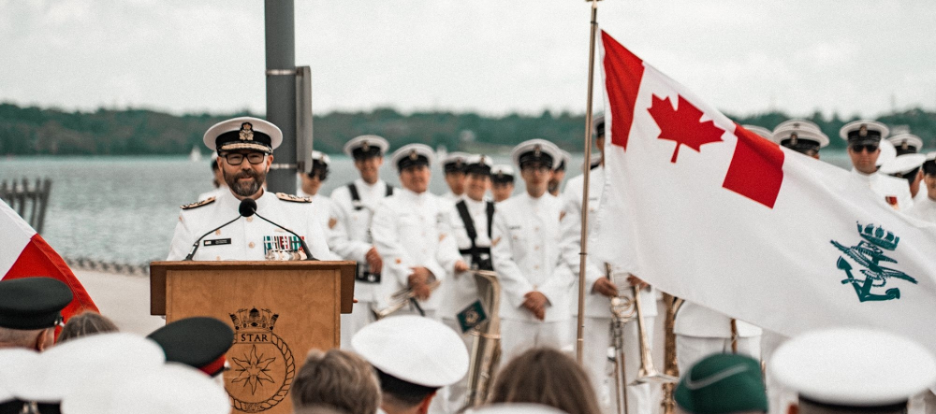

The former deputy commander becomes the 39th head of the RCN, with people, fleet and readiness as his stated priorities.
VAdm Dan Charlebois has assumed command of the Royal Canadian Navy, succeeding VAdm Angus Topshee during a ceremony at HMCS Star in Hamilton, Ontario.
Gen Jennie Carignan, Chief of the Defence Staff, presided over the June 16 change of command, held with the Second World War destroyer HMCS Haida in the background.
The handover
Charlebois becomes the 39th Commander of the Royal Canadian Navy. He most recently served as the navy’s deputy commander and has held a range of command and staff positions during his 34-year career.
“I am humbled and honoured to assume the watch as Commander of the Royal Canadian Navy,” Charlebois said. “Our sailors, together with our civilians and the families who support them, are the foundation of everything we do.”
Topshee leaves the position after four years as commander. He is expected to become Vice Chief of the Defence Staff at a separate ceremony later this summer. Carignan credited Topshee with leading the navy through a period of significant change while strengthening readiness for future demands.
“As Vice-Admiral Dan Charlebois assumes command, he brings the experience, character, and commitment required to lead our Navy into its next chapter,” Carignan said.
People first
In his flag hoist signal published June 16, Charlebois credited Topshee with turning the tide on what he described as a seemingly insurmountable personnel crisis that followed the COVID-19 pandemic. He said that, for the first time in several decades, there is cause for optimism on the people front, while cautioning that the situation remains precarious.
His stated top priority is growing the navy’s trained effective strength to crew shore establishments and ships while supporting delivery of the future fleet.
He called it “the only path to building and sustaining a ready, resilient and relevant Navy.”
The fleet ahead
Charlebois inherits a fleet in the middle of a generational rebuild. He singled out the River-class destroyer and the Canadian Patrol Submarine Project as central to the balanced fleet mix he intends to prioritize.
“In the Canadian context, to safeguard our nation and our interests, mass matters,” he said.
The River-class destroyers will replace both the retired Iroquois-class destroyers and the Halifax-class frigates, forming the backbone of the future surface fleet. The submarine project is advancing toward the acquisition of up to 12 conventionally powered boats intended to operate across the Atlantic, Pacific and Arctic.
The programs sit at different stages. The River-class project is moving through detailed design and long-lead procurement, while the submarine project is advancing toward acquisition after narrowing its field of qualified suppliers.
Fight tonight
Charlebois also signalled that investment in the existing fleet cannot wait for future platforms.
He said the navy must ensure the Halifax-class remains “not only safe and seaworthy, but also a credible blue water ASW platform ready to fight tonight.”
He also called on sailors to remain students of their profession, prepared for the next challenge rather than the last.
VAdm Dan Charlebois takes command of Royal Canadian Navy
