
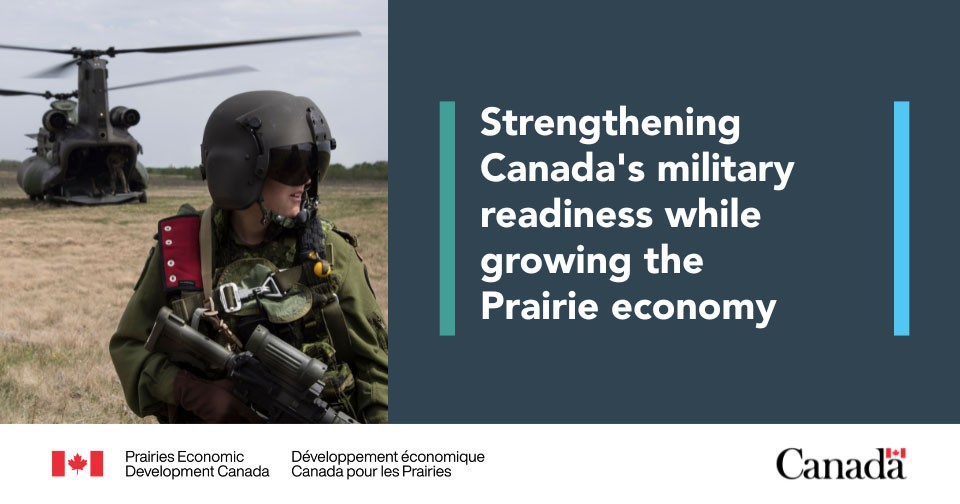

Canada’s push to meet NATO’s 2% defence spending benchmark is proving to be more than a fiscal milestone—it is rapidly becoming a catalyst for long-term military readiness and economic transformation across the country, particularly in Alberta and the Prairie Region.
Against a backdrop of growing global instability, the federal government has accelerated efforts over the past year to rebuild, rearm, and reinvest in the Canadian Armed Forces (CAF). Achieving the 2% target—five years ahead of schedule—marks a significant inflection point. But officials are clear: this is not the finish line. It is the foundation for a sustained, whole-of-government effort to modernize Canada’s defence posture and strengthen its role at home and abroad.
At Canadian Forces Base Edmonton, the Honourable Eleanor Olszewski underscored how defence spending is now serving a dual purpose—enhancing operational readiness while generating tangible economic outcomes. As Canada looks ahead, the government has committed to delivering approximately half a trillion dollars in defence investment over the next decade, positioning the country to meet NATO’s evolving benchmark of 5% of GDP by 2035.
This long-term trajectory is expected to reshape Canada’s defence industrial base. Increased spending is already driving innovation, expanding supply chains, and opening new opportunities for businesses—particularly small and medium-sized enterprises (SMEs)—to integrate into defence programs.
A key mechanism for this shift is Prairies Economic Development Canada’s Regional Defence Investment Initiative (RDII). Backed by $379.2 million over three years, the initiative is designed to accelerate the participation of regional businesses in defence supply chains while strengthening their innovation capacity. In Alberta, where the Department of National Defence and the CAF already support more than 12,000 jobs and $1.15 billion in investment, the program is expected to build on a well-established economic and industrial base.
“As Canada rebuilds, rearms, and reinvests in the Canadian Armed Forces to support our women and men in uniform and keep Canadian safe, we are also creating new opportunities for workers and businesses across the country. By investing in domestic defence industrial capacity through the Regional Defence Investment Initiative, Canada’s new government is helping ensure that provinces like Alberta can build on its strengths, contribute to Canada’s defence capacity, and share in the economic benefits of this work,” conveyed the Honourable Eleanor Olszewski, Minister of Emergency Management and Community Resilience and Minister responsible for Prairies Economic Development Canada.
The government’s approach ties defence spending directly to economic resilience, with a focus on building domestic capacity while ensuring the CAF has access to the tools it needs in an increasingly complex threat environment.
“This investment gives the Canadian Armed Forces the modern capabilities they need to operate effectively in today’s complex security environment. It strengthens readiness, supports our people and their families, and drives economic growth through Canadian industry. It’s a clear signal that Canada stands ready to defend our nation and contribute meaningfully to NATO,” said the Honourable David J. McGuinty, Minister of National Defence.
As Canada moves beyond the 2% benchmark, the emphasis is shifting toward sustained investment, capability delivery, and industrial growth. The result is a defence strategy that not only enhances military effectiveness, but also anchors economic opportunity—ensuring the Defence Team remains prepared, resilient, and ready to meet the demands of a rapidly changing world.
