
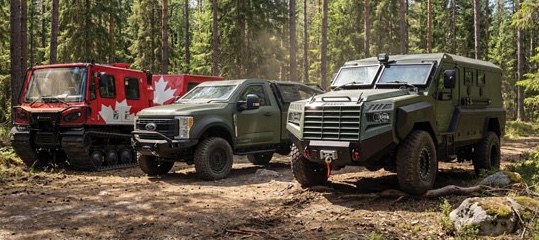

As Ottawa backs its boldest defence industrial policy in a generation, Brampton’s Roshel is positioning itself at the centre of Canada’s sovereign armoured vehicle capability — from the steel in the ground to the fleet on the front line.
When Prime Minister Mark Carney unveiled Canada’s first-ever Defence Industrial Strategy in February 2026, the message was unambiguous: Canada would stop sending three-quarters of its defence capital budget south of the border. With a commitment to direct 70 per cent of defence acquisitions to Canadian firms — backed by more than $500 billion in projected investment over a decade and a historic achievement of the NATO two-per-cent spending target — Ottawa has issued a long-term call for greater engagement from domestic industry.
The Brampton, Ontario-based manufacturer of smart armoured vehicles has spent the past decade quietly building one of the most vertically integrated defence production operations in the country. Now, with the policy winds firmly at its back, Roshel is executing a series of bold moves designed to make Canada genuinely sovereign in the production of armoured vehicles — from the raw steel that forms their hulls to the finished platforms rolling off the line.
Forging Sovereignty: The Roshel Algoma Defence Partnership
Perhaps the most strategically significant step came in April 2026, with the announcement of Roshel Algoma Defence — a joint venture with Algoma Steel Group, one of Canada’s largest domestic steelmakers, headquartered in Sault Ste. Marie, Ontario. The partnership creates a Canadian Centre of Excellence for Ballistic Steel Production, targeting the domestic manufacture of specific high-hardness ballistic steel grades that Canada currently imports entirely from abroad.
The strategic implication is profound. While Canada has long produced some grades of ballistic steel, specific high-performance grades — the very ones required for next-generation armoured vehicle programs — have until now been sourced entirely from foreign suppliers. Roshel Algoma Defence closes that gap, establishing full-cycle sovereign production of those critical grades within Canada: from forming and heat treatment through fabrication, welding, and machining. More than 500 manufacturing jobs are expected to be created in Sault Ste. Marie alone, and the venture directly underpins Canada’s LUV and DAME programs, domestic submarine construction, and future shipbuilding requirements under the National Shipbuilding Strategy.
“Canada’s Defence Industrial Strategy calls for partners who build here, invest here, and stay here. Roshel was already doing that before the policy existed.”
LUV: Canada’s Next Light Tactical Fleet
The Canadian Army’s Light Utility Vehicle program is one of the most consequential near-term procurement decisions Ottawa will make — and Roshel is well placed to meet it. What sets Roshel apart is not a proposal on paper, but a combat-proven platform already in service with law enforcement and security forces across Canada and around the world. These are vehicles that have been tested under real operational conditions, not a prototype engineered to meet a checklist.
Equally compelling is Roshel’s parts and service commonality advantage. Fleets in the field are only as capable as the supply chains that sustain them. Roshel’s vehicles share components, systems, and service infrastructure across its entire product family — meaning that a Canadian Army unit in Victoria and one in Halifax draw from the same parts ecosystem, supported by the same domestic service network. That kind of coast-to-coast supportability, grounded in a Canadian manufacturer with Canadian facilities, is not something a foreign OEM can replicate. For the LUV program, it may prove to be the decisive argument.
The Arctic Imperative: DAME
Canada’s Arctic is not a future problem — it is a present one. The Domestic Arctic Mobility Enhancement program demands a vehicle that can operate where roads end and the temperature does not. Roshel’s answer is built in Canada, for Canada. Through an exclusive agreement with ST Engineering, Roshel will manufacture the ExtremV amphibious all-terrain vehicle domestically — not import it, not badge-engineer it, but build it here, with Canadian workers, supported by Canadian supply chains.
What makes Roshel’s proposition distinctive is the depth behind the platform. Unlike off-the-shelf foreign solutions, Roshel brings the ability to deliver armoured variants of the Arctic vehicle — a capability that few competitors can offer and that the evolving threat environment in the High North makes increasingly relevant. Beyond the vehicle itself, Roshel offers full lifecycle integration: customization to Canadian Armed Forces operational requirements, indigenous technical support, and a service and maintenance network that does not depend on a parts pipeline running through a foreign country. In a domain as unforgiving as the Arctic, that self-sufficiency is not a commercial advantage — it is an operational necessity.
“The strongest defence industrial base is not built through contracts — it is built through commitment. Roshel’s commitment to Canada runs from the steel mill to the Arctic and every fleet in between.”
Canada’s Defence Industrial Partner — Not Just a Supplier
Taken together, what Roshel is building is something that goes well beyond a competitive position on individual programs. The company is establishing itself as a long-term strategic partner to the Government of Canada — a domestic anchor in the armoured vehicle sector that Ottawa can rely on not just for this procurement cycle, but for the decades of fleet management, capability evolution, and sovereign industrial capacity that follow.
A Pivotal Moment
The pieces Roshel has assembled — sovereign steel, a domestic OEM collaboration, combat-proven platforms, Arctic manufacturing capability, and a service network that spans the country — form a coherent industrial vision at exactly the right moment. Canada has declared its intent to build its own defence future. Roshel is already building it.
