


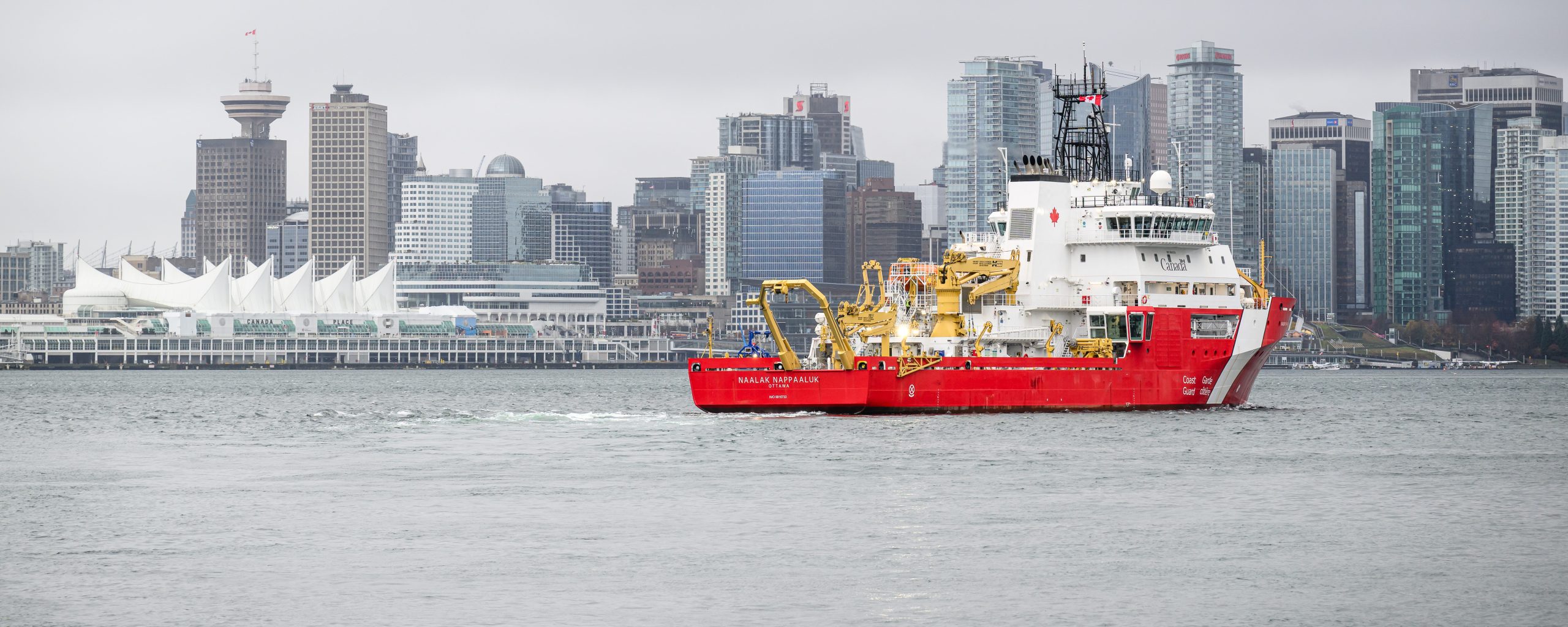
At the Bedford Institute of Oceanography in Dartmouth, Nova Scotia, a new chapter in Canada’s ocean science capability officially began. With the ceremonial breaking of a bottle across its bow, the Canadian Coast Guard Ship (CCGS) Naalak Nappaaluk was welcomed into service—marking the arrival of the largest science vessel in the Government of Canada’s fleet.
Built at Seaspan’s Vancouver Shipyards, the Offshore Oceanographic Science Vessel represents both a technological milestone and a strategic investment in Canada’s ability to understand and protect its waters. Designed to operate across the Atlantic and Arctic, the ship will support scientific missions, gather critical data, and enable research that informs both domestic policy and international commitments on ocean sustainability.
The vessel’s role comes at a pivotal time. Canada’s Atlantic waters are among the richest marine ecosystems in the world, and the pressures facing them—from climate change to resource management—continue to grow. With modern, Canadian-made equipment onboard, Naalak Nappaaluk will support scientists from Fisheries and Oceans Canada and Natural Resources Canada, enhancing the country’s ability to monitor, study, and respond to these evolving challenges.
The ship also carries deep cultural and symbolic significance. Named after Naalak Nappaaluk, an Inuit knowledge holder, the vessel reflects a commitment to reconciliation and the recognition of Indigenous knowledge systems in understanding Canada’s northern environments.
“Inuit are the original scientists in Inuit Nunangat, our Arctic homeland, and Naalak Nappaaluk was one of them. Not only did he possess life-saving knowledge about the land, the sea, the weather and the night sky, he was committed to ensuring that knowledge was preserved for future generations. The CCGS Naalak Nappaaluk, and the researchers connected to her, will continue this tradition at a time when Inuit Nunangat is rapidly changing. We look forward to strengthening our partnership with the Canadian Coast Guard so that Inuit, and all Canadians, can better understand these changes,” explained Natan Obed, President, Inuit Tapiriit Kanatami.
The ship’s delivery underscores the broader ambitions of Canada’s National Shipbuilding Strategy (NSS), which aims to renew federal fleets while revitalizing the domestic marine industry. From shipbuilders and engineers to suppliers across the country, the program is designed to generate long-term economic and industrial benefits while strengthening sovereign capability.
“The delivery of the CCGS Naalak Nappaaluk is exactly what the National Shipbuilding Strategy was designed to do. It means real work for Canadian shipbuilders, engineers, and suppliers from coast to coast. It means high-quality jobs today, and a stronger industrial base for tomorrow. And it means Canada has the modern science and ocean capability we need to better understand, protect, and manage our waters. This is how we build long-term value: by investing in Canadian expertise, supporting good jobs here at home, and making sure public investments deliver lasting benefits for Canadians,” stated the Honourable Joël Lightbound, Minister of Government Transformation, Public Works and Procurement and Quebec Lieutenant.
For Canada’s defence and security leadership, the vessel stands as both a scientific and strategic asset.
“I am pleased to welcome the CCGS Naalak Nappaaluk into service. This science ship stands as a testament to Canadian innovation, skilled shipbuilders, and the National Shipbuilding Strategy’s long-term vision. We are investing in both the future of ocean research and the resilience of coastal communities that depend on healthy seas,” expressed the Honourable David J. McGuinty, Minister of National Defence.
The ship’s homecoming to Dartmouth also highlights Atlantic Canada’s growing role as a hub for ocean innovation, defence, and advanced research.
“Nova Scotia, and Atlantic Canada more broadly, is not a region waiting for opportunity; we create it. Dartmouth is already a hub for ocean technology, defence innovation, advanced research, and the talent that powers those sectors. As someone who has spent my career working to connect people to opportunity, I know that the greatest investments we can make, are in regions that have the drive, the ingenuity, and the infrastructure to deliver results. Atlantic Canada is one of those regions,” conveyed the Honourable Lena Diab, Minister of Immigration, Refugees and Citizenship.
Operationally, Naalak Nappaaluk is expected to play a central role in advancing Canada’s marine science agenda for decades. From offshore geology and marine ecosystems to Arctic environmental change, the vessel will enable critical research and support missions ranging from data collection to search and rescue.
“In a changing ocean environment, Canada is empowered by advanced technology and the expertise needed to monitor, understand, and respond to ocean challenges. The CCGS Naalak Nappaaluk will enable critical research and science in the Atlantic and Arctic oceans, strengthening our leadership in marine science for decades to come. This is an investment in healthier oceans and the communities that depend on them,” said the Honourable Joanne Thompson, Minister of Fisheries.
“The CCGS Naalak Nappaaluk will support essential Atlantic research to strengthen our understanding of Canada’s offshore geology, resources, and marine environment. Natural Resources Canada looks forward to testing and deploying scientific equipment onboard and actively using this vessel to deliver key marine science programs that advance Canada’s commitments to sustainable ocean management at home and abroad,” noted the Honourable Tim Hodgson, Minister of Energy and Natural Resources.
Locally, the vessel’s arrival reinforces the importance of the Bedford Institute of Oceanography and the broader region’s contribution to national capability.
“Here in Sackville—Bedford—Preston, we are proud to be home to world-class ocean research at the Bedford Institute of Oceanography and to the dedicated Canadian Coast Guard personnel who serve Canadians every day. The arrival of the CCGS Naalak Nappaaluk right here in our community strengthens that legacy and highlights the vital role our region plays in advancing marine science and protecting our oceans for future generations,” remarked Braedon Clark, Member of Parliament for Sackville—Bedford—Preston.
For the Canadian Coast Guard, the ship represents a step change in operational capability—one that blends science, sovereignty, and service.
“The dedication of the CCGS Naalak Nappaaluk marks a historic milestone for the Canadian Coast Guard. As our largest and most advanced science vessel, built right here in Canada, this ship will significantly strengthen our ability to understand and respond to changes in the Atlantic and Arctic oceans, support critical research, and carry out essential missions such as search and rescue. Named in the spirit of reconciliation, the Naalak Nappaaluk reflects our respect for Inuit knowledge and our shared commitment to protecting Canada’s oceans for generations to come,” remarked Kevin Brosseau, Commissioner, Canadian Coast Guard.
As it begins operations, Naalak Nappaaluk stands at the intersection of science, industry, and sovereignty—an enduring symbol of Canada’s commitment to understanding its oceans and safeguarding them for generations to come.
