
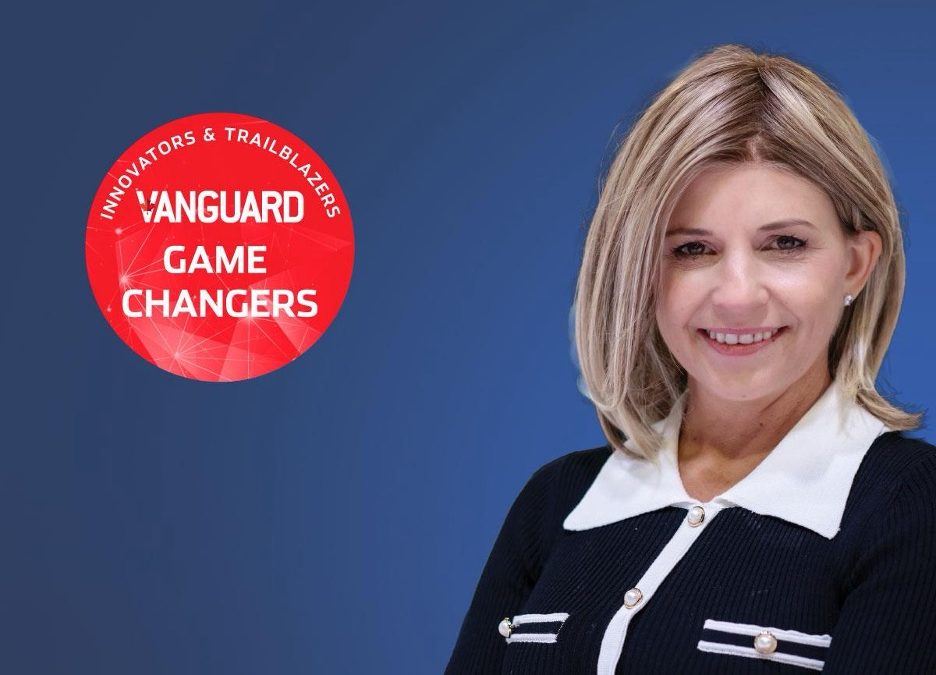

Head of Sales, Airbus Helicopters in Canada
Sonja Woods began her career in government relations, where she discovered that she was most drawn to organizations delivering tangible, mission-critical capabilities. That interest led her into defence procurement and eventually to Airbus Helicopters in Canada.
After holding roles in government relations and communications, Woods led the H135 campaign for the Future Aircrew Training program. She later served as Director of Specialty Sales, leading market segment specialists across North America, before becoming Head of Sales for Airbus Helicopters in Canada.
Today, she leads the company’s government and commercial sales teams as Canada undertakes a broad modernization of its defence and security fleets. Vanguard spoke with Woods about overcoming imposter syndrome, leading through long defence procurement cycles and the shift toward integrated ecosystems connecting crewed aircraft, autonomous systems and digital networks.
How did you start out in this industry and how has it brought you to where you are today?
I began my career in government relations, where I quickly realized that I was drawn to organizations that delivered tangible, mission-critical capabilities far more than focusing solely on policy. That interest led me into defence procurement and, ultimately, to moving in-house at Airbus Helicopters in Canada.
After holding various roles in government relations and communications, I served as the campaign leader for the Future Aircrew Training (FAcT) project. Successfully positioning the H135 for that campaign opened the door to new opportunities within Airbus, specifically into sales and marketing. I subsequently spent three years as Director of Specialty Sales, leading our market segment specialists across North America. This role gave me invaluable insight into our customers, their unique operational missions, and the broader commercial landscape.
Today, as Canada executes an ambitious plan to modernize its defence and security fleets, I have the privilege of leading both our government and commercial sales teams. It is a role that allows me to combine my passion for strategic stakeholder engagement with the opportunity to help deliver capabilities that contribute to Canada’s security, readiness and long-term aerospace competitiveness.
What is your role at your organization today?
I am Head of Sales for Airbus Helicopters in Canada, leading our commercial and government sales teams. In this role, I am responsible for driving market growth, strengthening key stakeholder partnerships, and ensuring our solutions align with the complex, evolving needs of Canadian operators.
What was your most challenging moment?
In my experience, the greatest challenge lies in sustaining a team’s belief through the long life cycle of a major defence campaign. Defence procurement operates on timelines measured in years rather than months, and success requires teams to remain focused through changing priorities, evolving requirements and intense scrutiny.
Leadership in these high-pressure environments requires a delicate balance: you must absorb organizational pressure and project the energy and enthusiasm needed to keep your team aligned behind a common objective. Yet, when a campaign faces a difficult shift in momentum, the pressure intensifies from all sides. I am fully invested in everything I do, so the real challenge in those critical moments is maintaining the inner calm required to lead effectively, ensuring that the sheer weight of expectations never compromises my focus.
What was your A-HA moment or epiphany that you think will resonate most with our reader, tell us that story.
My biggest epiphany was overcoming the imposter syndrome that often affects those with non-traditional backgrounds in this industry. Not being a veteran, a pilot, or an engineer, I initially doubted my place at the table.
The turning point occurred when I was tapped to lead the North American specialty sales team. It forced me to objectively assess my own experience and recognize that I had been measuring myself against the wrong benchmarks. I came to understand that leadership is not about being the foremost technical expert in the room. Particularly in the defence sector, leadership is about creating the conditions for expertise to succeed. My strengths in emotional intelligence, relationship building and strategic alignment were not only valuable – they were essential.
That was my ‘A-HA’ moment. As a leader, your job isn’t to know how to do everyone else’s job. Your job is to surround yourself with a diverse range of expertise and harmonize it. After all, a piece of music is only compelling when the musicians are playing different, complementary notes.
What is the one thing that has you most fired up today?
Without a doubt, it is the sheer scale of opportunity in front of both Airbus and Canada. Having witnessed Airbus in Canada grow from 300 employees when I started to more than 5,300 today has been remarkable. We have established a powerful foundation, and I see a clear path to accelerate this momentum, especially across our helicopter portfolio.
At the same time, we are witnessing a generational shift in how governments think about security, sovereignty and operational readiness. Canada is making significant investments in defence modernization, creating opportunities not only to strengthen military capability, but also to grow domestic industrial capacity, develop highly skilled talent and reinforce Canada’s position within the global aerospace ecosystem.
That convergence is what excites me most. Airbus is uniquely positioned to support those priorities through advanced rotary-wing capabilities, emerging autonomous technologies and long-term partnerships that help operators succeed in increasingly complex environments.
I am incredibly energized to lead our helicopter and UAS sales organization as we capture new market opportunities, support our operators, and help shape the next chapter of Canada’s aerospace and defence industry.
What is the best advice you received?
The best advice I received is a simple but powerful triad: ‘Be humble, hungry, and smart.’ Humility keeps you grounded and focused on the team. Hunger gives you the drive to relentlessly pursue growth. Being smart – specifically in terms of emotional intelligence – allows you to navigate complex stakeholder relationships. It is a combination I look for when building my own teams, and it is what I strive to embody every day.
What is a habit that contributes to your success?
One of my most impactful habits stems from an unconventional source: my time at a specialized arts high school for drama. In improvisation, a core rule of success is to say ‘Yes, and…’ – meaning you accept a contribution and expand from there. I have carried this into my leadership philosophy.
For me, it doesn’t mean agreeing with everything. Instead, it represents a mindset of collaborative growth. I always look for ways to build on the ideas of my team and partners, striving to put more value on the table than I take off. Approaching leadership and teamwork through this lens has been one of the greatest drivers of my success.
What people or organizations do you believe best embody the innovation mindset?
The innovation mindset is best embodied by intellectually curious, action-oriented professionals who refuse to be paralyzed by complexity. These are individuals who look at intricate, high-stakes challenges not as roadblocks, but as catalysts for creative problem-solving. The organizations that truly lead are those that refuse to view complex operational constraints as permanent barriers. Instead, they foster an environment where curiosity is celebrated and obstacles are treated as invitations to pioneer next-generation capabilities, rather than excuses to maintain the status quo.
How is your organization changing the game within your industry sector?
Airbus Helicopters is shifting the paradigm from standalone rotary-wing aircraft to fully integrated, multi-mission air ecosystems. We are changing the game by pioneering Crewed-Uncrewed Teaming – allowing crews to seamlessly command uncrewed assets directly from the helicopter in flight. This capability extends operational reach and situational awareness, allowing uncrewed systems to conduct tasks such as reconnaissance and surveillance while the crewed helicopter remains at a safe distance. Through an intuitive, ergonomic tablet interface and user-friendly human-machine interface, operators can rapidly integrate uncrewed capabilities into their missions while maintaining focus on their primary tasks.
Combined with our proven dual-use strategy, we deliver military and government platforms backed by the economics, reliability, and maturity of a global commercial supply chain. Ultimately, we are enabling operators to execute missions more effectively, with greater flexibility, enhanced situational awareness, and with unprecedented tactical connectivity.
What are some of the biggest impediments to innovation in your industry sector?
Developing cutting-edge defence and aerospace solutions requires advanced engineering, digital expertise, and extensive resources. Ensuring a steady, reliable pipeline of both highly skilled professionals and foundational resources remains our industry’s most pressing challenge to sustaining rapid innovation.
How has innovation become engrained in your organization’s culture and how is it being optimized?
Innovation is in Airbus’ DNA and is optimized through customer collaboration. We have established distinct channels to gather continuous feedback from our operators allowing us to understand their evolving needs, mitigate pain points, and explore cutting-edge technologies together. This proximity to the customer ensures our innovation is always purposeful and ensures investment priorities are designed to deliver superior operational outcomes for our customers.
What technologies, business models, and trends will drive the biggest changes in your industry over the next two years?
Over the next two years, the biggest catalyst for change will be the intersection of rapid technological adoption and the flattening of traditional defence business models.
We are moving beyond standalone platforms toward interconnected operational ecosystems where crewed aircraft, autonomous systems and digital networks work together to deliver effects across the mission space. Technologies such as Crewed-Uncrewed Teaming and advanced automation are already transitioning from concept to operational reality.
At the same time, defence customers are increasingly seeking trusted partners capable of delivering not only platforms, but complete capability solutions supported by domestic industrial participation, sustainment and long-term growth.
The organizations that will succeed are those capable of combining technological innovation with operational relevance, industrial resilience and the ability to rapidly adapt to changing mission requirements.
What is your parting piece of advice?
Always listen for the subtext to fully grasp people’s underlying motivations. When you encounter resistance, avoid the instinct to simply push back; instead, seek to understand its root cause, which is often driven by an unspoken concern or operational fear. You can only solve complex problems once you truly comprehend the perspectives driving them.
Furthermore, while the sales community naturally attracts strong, extroverted personalities, leadership requires creating a balanced environment. It is vital to intentionally provide the forums and avenues for those who may not be hardwired to speak out, ensuring that diverse, highly valuable viewpoints are never drowned out by the loudest voices in the room.
