
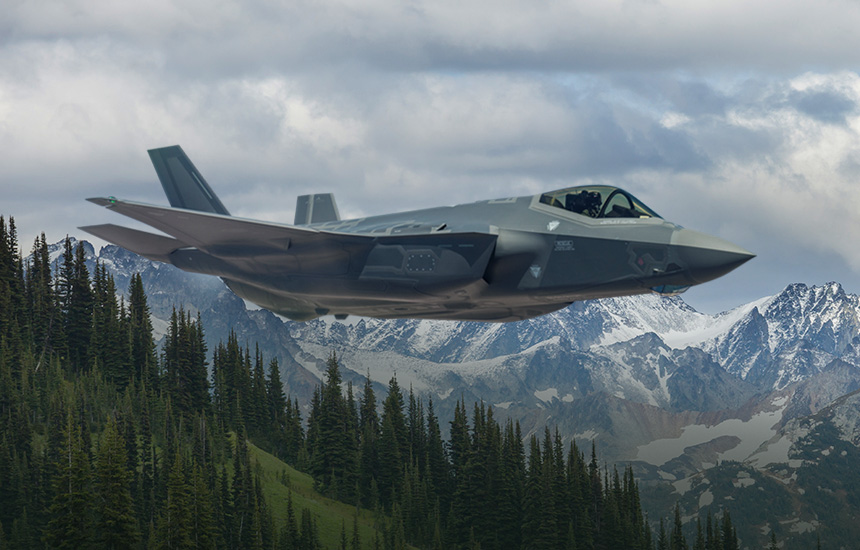

A Global Platform
The combat proven F-35 is rapidly becoming the backbone of NATO air power.
Today, twenty nations have selected the aircraft, and more are lining up. By the 2030s, more than 2,000 F-35s will be stationed around the world, from the Arctic to the Outback, creating a truly interoperable, network-centric global fleet.
That means every time Canada flies with allies, including 13 other NATO countries, the Royal Canadian Air Force will be speaking the same digital language, planning missions on the same data-rich platform and benefitting from the same global supply chain.
Cold Weather Proven
The F-35 can cruise at Mach 1.6, which is more than one and a half times the speed of sound.
But speed alone isn’t enough. The F-35A carries more fuel than CF-18s, giving it the range needed for long-haul patrols and deep strike missions without frequent refueling. Endurance is critical in the Arctic, where distances are vast and bases are sparse.
Following cold weather testing, the F-35 emerged fully qualified for Arctic operations. Today, F-35s are stationed in Alaska and Norway, with Finland receiving its first aircraft this year. Thorough drag chute testing and proven performance in icy conditions gives confidence that the aircraft can operate from bases like Canadian Forces base Cold Lake year-round.
One Aircraft, Many Allies
An air force the size of Canada’s likely deploys as part of a coalition.
Previously, training for coalition scenarios meant Canadian Hornets, Dutch F-16s, German Tornadoes and British Typhoons flying together. Each different platform required translation of tactics and data. Each had its own stock of spare parts and maintenance protocols.
In the future, all four air forces will fly the F-35.
That commonality means Canadian pilots will train, plan, and fight side-by-side with the same aircraft as our allies, reducing the logistics footprint, simplifying maintenance and improving coalition readiness.
Last year, the U.S. Air Force showed the value of F-35 allies with cross-servicing operations in Europe, when Norwegian maintenance crews received, refueled and re-launched American F-35s.
In a future where missions are fought in integrated, multi-domain environments, interoperability and flexibility are a strategic advantage.
Built by Canadians
Canadian companies are a critical part of the global F-35 supply chain, with $3.2M CAD in Canadian components in each jet in the current fleet of more than 1,255 aircraft. That’s before Canada receives its first aircraft.
Work will continue through at least 2058, with current and projected production and sustainment opportunities expected to produce over $15.5B CAD in industrial value for Canada.
Ready for What’s Next
As technology evolves, the F-35’s software system is built to evolve with it. Canada will benefit from the full coalition of operators’ investments in future upgrades, from teaming with uncrewed aircraft to advanced electronic warfare capabilities and improved target recognition.
The F-35 is more than a fighter upgrade. It’s a strategic enabler that aligns Canada’s industry and defence objectives with the realities of modern armed conflict.
