
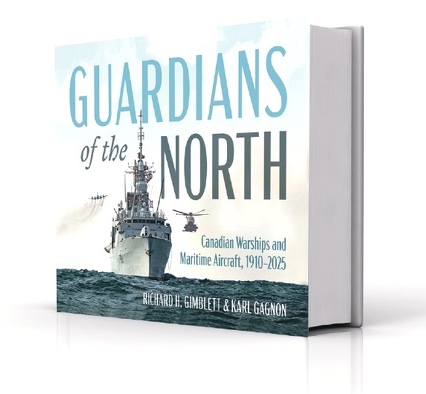

In a refreshing change to the traditional method of recounting historic fleets, the authors have compiled a complete listing of every ship (and submarine) type that has ever served in the Canadian navy (including embarked aircraft), accompanied throughout by magnificently detailed illustrations. Heretofore the authoritative reference books on the ships of Canada’s navy have been predominantly a short history of individual ships with an accompanying photograph, often only the best example that is readily available. Guardians of the North is a much different approach, a narrative history told through pictures and illustrations, in which it is both a definitive work of reference as well as wonderfully engaging narrative of how these ships (Part 1) and aircraft, both shipborne (Part 2) and land-based (Part 3) came to be in the service of Canada. Each of the 58 chapters deals with a specific class of ship or supporting aircraft, in chronological order of service. In addition to some cleverly sourced photographs, selected to best tell the story, there is a superb side profile drawing (in exquisite detail) that reflects physical size (with scale in the legend) as well as structural and cosmetic changes during the service life of the class.
The authors are both former serving naval officers. Richard Gimblett is extensively published as the former Command Historian of the Royal Canadian Navy, and he has deftly capitalized on his decades of research by combining again with Karl Gagnon’s graphic artistic skill sets. They were first influential in their 2009 collaboration on The Naval Service of Canada, 1910-2010: The Centennial Story and later in 2010 Citizen Sailors – Chronicles of Canada’s Naval Reserve 1910-2010. Building on their successful formats in previous works, supported by a very handy index and well researched endnotes, each chapter ends with a short vignette suggesting further reading for those looking for more detail. Moreover, in “a note on sources” on page 355, the authors explain the challenge of attribution with the numerous published sources used in this book, both RCN and maritime aviation now resident under the RCAF. Hence their preference for endnotes instead of footnotes, accompanied by a select bibliography and the previously mentioned recommendations for further reading. Furthermore, the appendices are a compilation of some very useful (and often misquoted) facts on ship classes, aircraft type specifications and their various weapons fits.
As a former nerdy junior officer fond of reading Jane’s Fighting Ships (ostensibly to stay awake on a quiet middle watch), one can only try to appreciate the incredible level of research required to produce a work of this calibre. While it will appeal to anyone looking for facts on certain Canadian ships, submarines and aircraft, Guardians of the North offers much more, as it has an easy-to-read narrative that caters to the full spectrum of readership, from interested layperson to serious historian. Importantly, the Afterword is essential reading, as it skillfully brings the entire project together, geopolitically, to the time of writing in Spring 2025. I was particularly taken by the subtle comparison of the challenges facing the current Commander of the RCN, Vice-Admiral Angus Topshee, with his post-war predecessor, Vice Admiral Harold Grant, who was responsible for building the Cold War fleet in equally uncertain times.
Uniquely introduced with two Forewords, one by the Commander of the Royal Canadian Navy representing the ships and the other, appropriately, by the Commander of the Royal Canadian Air Force representing the maritime aviation assets – this book is an account of the process of warship and maritime aircraft acquisitions, which is a continuing story. But to me it is more than a definitive history of Canada’s naval and maritime air forces, it is also an illustrative reflection of the political will of successive Canadian governments, in peace and war, and their determination to restrain any illusions of naval grandeur and constrain a navy to a frugal existence based on a minimalist fleet of frigates and destroyers, eschewing large capital ships. But times have changed, and the small ship navy envisioned by Prime Minister Laurier may be changing, as destroyers grow in size and complexity and submarines represent a necessary larger part of standing naval forces.
Attractively priced for a hardcover of this size and standard, it offers the benefits of an official history packaged in a pleasantly readable book. This work is meticulously researched and in addition to being a complete history of naval Canada’s fleets, it offers a brief look into the immediate future with River-class destroyers, Protecteur-class replenishment ships and P8 maritime patrol aircraft. I would recommend Guardians of the North, without hesitation, to anyone with an interest in the “what” that has comprised Canada’s naval forces since inception, as it will likely surprise many with some heretofore unknown recapitalization initiatives. Besides, it has been written by two Canadian naval officers who have actually served in these ships – this makes it refreshingly different from almost all other accounts.
