

Carney’s Ankara summit produced Canadian-only procurement opportunities, major contracts, and new routes into NATO markets, alongside the submarine decision already making headlines
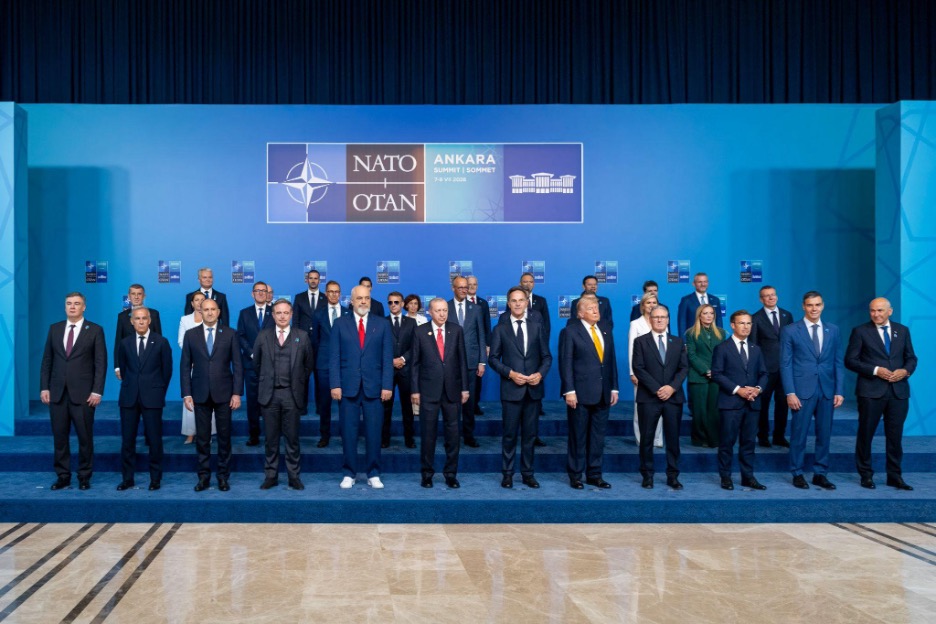
Prime Minister Mark Carney’s July 6 to 8 trip to the NATO Summit in Ankara produced a wide package of contracts, Canadian production orders, financing initiatives, and NATO market-access tools, on top of the TKMS submarine decision that dominated headlines.
Canadian production
The most revealing industrial announcement wasn’t the largest one. Ottawa restricted the militarized portion of its Light Utility Vehicle competition to two Canadian suppliers, turning Buy Canadian from policy into a live procurement decision. The $180 million, five-year competition covers the militarized vehicle fleet and associated trailers, though Ottawa hasn’t publicly identified the two eligible suppliers.
Ukraine assistance includes close to $800 million in confirmed Canadian production, plus another $50 million for IT, cyber support, and engineering equipment. Ottawa allocated $400 million over three years for more than 39 million rounds of small, medium, and large-calibre ammunition manufactured in Canada, with General Dynamics Ordnance and Tactical Systems-Canada named as the partner; the package also includes rifle-conversion kits, protective equipment, and more than two million training rounds. Nearly another $400 million over two years goes to General Dynamics Land Systems-Canada for 35 Canadian-built armoured combat support vehicles, 10 ambulances and 25 mobile recovery vehicles, plus training, weapons systems, and in-service support. Another $50 million funds IT and engineering equipment, including $34 million for IT and cyber support, industry-led certification training, software licences, and AI-generated 3D mapping products, along with backhoe loaders and spare parts. The government hasn’t said the full $50 million will be sourced from Canadian companies.
Telesat also reached an agreement in principle with Ottawa for the Enhanced Satellite Communications Project-Polar, covering the Military Ka-band component and using Telesat Lightspeed to provide continuous Arctic communications, including beyond-line-of-sight connectivity. It builds on the strategic partnership with Telesat and MDA Space announced in December 2025. No value has been published, and the final contract hasn’t been signed.
Major capability purchase
Canada signed an approximately $800 million, eight-year contract with Kongsberg Defence and Aerospace for Joint Strike Missiles, covering the missiles, supporting hardware, technical data, and training for future RCAF fighters including the F-35. No Canadian workshare has been announced here. Any additional Canadian industrial opportunity will depend on how integration, training, and long-term support are structured.
GlobalEye moves onto two tracks
NATO selected Saab GlobalEye as its new airborne warning and control system, with Canada joining 10 other allies, Belgium, Denmark, Germany, Latvia, Lithuania, Luxembourg, the Netherlands, Norway, Romania, and Sweden, in a joint procurement of up to 10 aircraft. Saab will now enter formal negotiations with the NATO Support and Procurement Agency, but no contract has been signed. The NATO decision follows Canada’s May selection of Saab as preferred supplier for its separate national AEW&C requirement, where Canada and Saab are still negotiating. GlobalEye is built on Bombardier’s Global 6500, giving both procurements a Canadian industrial connection. Saab has also teamed with CAE for training and simulation as part of its Canadian offer.
Space access
Canada joined NATO’s STARLIFT initiative as its 15th participant, examining a network of allied launch capabilities that could deploy assets at short notice from spaceports across the Alliance. Canada is also one of eight participants in HALO, alongside Denmark, Finland, Germany, the Netherlands, Norway, Sweden, and Türkiye, an initiative intended to connect sovereign, nationally owned military satellites into a networked constellation supporting communications, intelligence, and missile tracking. Both initiatives position Canada to draw on multinational space capabilities that would be costly and time-consuming to develop nationally.
Separately, German launch company Isar Aerospace signed an agreement with Maritime Launch Services for access to infrastructure and launch services at Spaceport Nova Scotia, a direct role for Canadian space infrastructure in NATO’s wider space-capability push, even without a Canadian government contract attached.
A front door into NATO
NATO launched the Front Door for Industry, a single, simplified point of access to procurement opportunities, innovation events, and engagement channels. The more consequential piece may be NATO’s first consolidated, unclassified demand signal, intended to outline key innovation priorities and capability requirements over the coming years. For Canadian firms, especially SMEs without established NATO relationships, that should provide earlier visibility into Alliance requirements.
NATO also launched the NATO Engine, a cross-border manufacturing network intended to connect available factory capacity and foster collaboration among European, Canadian, and US companies. The first pilot is most relevant to firms working in additive manufacturing, engineering services, and manufacturing-as-a-service.
Capital and financing
Eight countries, Albania, Belgium, Greece, Latvia, Luxembourg, Romania, Türkiye, and Ukraine, expressed support for working toward the establishment of the Defence, Security and Resilience Bank. Canada was previously selected to host the Bank’s future headquarters, with BDC President and CEO Isabelle Hudon serving as Canada’s lead negotiator. The proposed institution is intended to lower financing costs and mobilize capital for defence, security, and resilience projects, including by addressing financing gaps facing smaller companies. The bank isn’t operational and isn’t accepting applications; participating countries are targeting operations as early as 2027, subject to domestic treaty processes.
Canada is also negotiating to join Sub-Fund 1 of the NATO Innovation Fund, with negotiations expected to conclude before the end of 2026. Participation could give eligible Canadian companies access to investment capital, strategic networks, and transatlantic markets. Canada will also host the 2027 NATO Industry Forum, a home-field opportunity to engage NATO officials and allied defence and technology companies.
Bilateral openings
Canada and Germany launched negotiations toward a Strategic Partnership Agreement covering security and defence, technology, space, investment, energy, supply chains, and critical minerals. The agreement, targeted for completion before the end of 2026, builds on expanding industrial ties between the two countries, including the TKMS submarine partnership.
Canada and Türkiye signed a Statement of Intent covering military dialogue, operational support, and the possible development of a defence-industrial cooperation agreement, alongside the separate launch of free trade negotiations. Canada and France renewed their bilateral defence cooperation framework, covering interoperability, science and technology, military cooperation, and capability development. None of these agreements included an immediate contract, but all three create frameworks for future military and industrial cooperation.
What comes next
Ottawa hasn’t published a timeline for converting the Telesat agreement in principle into a definitive contract, and it hasn’t identified the Canadian suppliers eligible for the militarized Light Utility Vehicle competition. Saab and NATO now head into formal negotiations through the NATO Support and Procurement Agency, while Canada’s separate AEW&C discussions continue in parallel, and Canada expects to conclude its NATO Innovation Fund negotiations before the end of 2026. Taken together, the summit produced three types of opportunity: direct openings for Canadian production through the vehicle competition and Ukraine orders, emerging routes through Telesat, GlobalEye, and NATO’s new industry tools, and longer-term access to financing and allied markets through the defence bank, the Innovation Fund, and the bilateral frameworks.
