
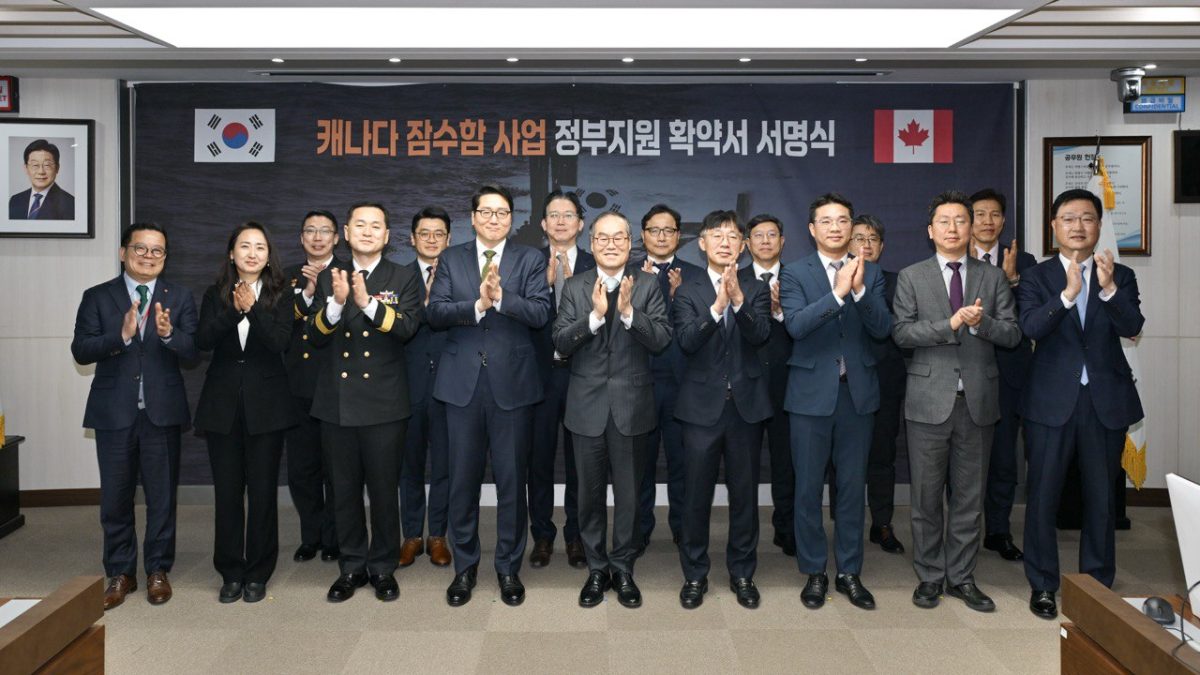

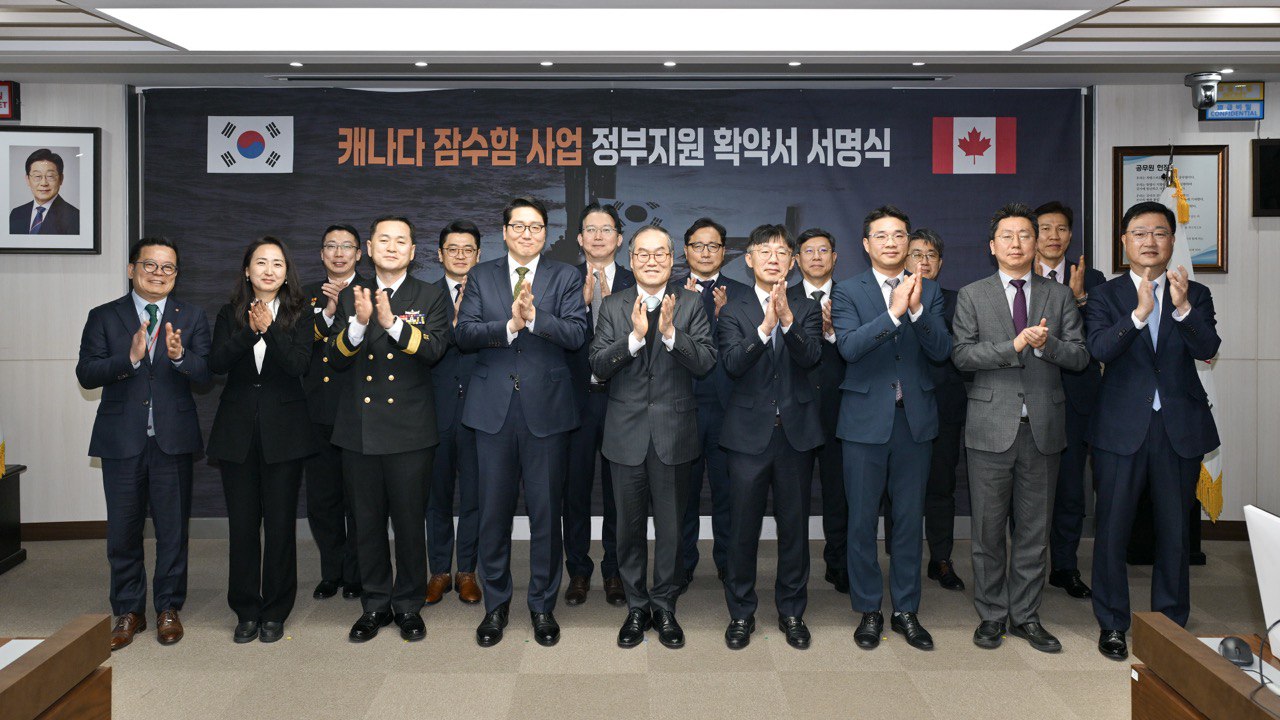
On February 20, inside the Gwacheon Government Complex, the Republic of Korea made something unmistakably clear: its bid for Canada’s Patrol Submarine Project is not just an industrial proposal — it is a coordinated national commitment.
Hosted by the Defence Acquisition Program Administration (DAPA), and led by Minister Lee Yong Cheol, the ceremony marked the signing of a Government Letter of Commitment in support of the bid led by Hanwha Ocean and supported by HD Hyundai Heavy Industries for Canada’s Patrol Submarine Project (CPSP).
But this was more than a formal signing. It was a declaration of intent from Seoul — a signal to Ottawa that the Republic of Korea is prepared to back its industry with the full weight of government coordination.
A Bid Anchored in National Commitment
The Letter of Commitment affirms the Republic of Korea Government’s determination to systematically support both the CPSP bid and the implementation of Canada’s Industrial and Technological Benefits (ITB) requirements. In the CPSP competition, performance, delivery schedule, and price matter — but so too does the ability to deliver 100% ITB fulfillment.
That obligation is not peripheral. It is central to Canada’s evaluation framework.
Recognizing this, the Korean government moved early. Through interagency coordination led by the Cheong Wa Dae — the Korean presidential office — relevant ministries jointly identified and developed industrial cooperation initiatives. Those initiatives have now been incorporated directly into the bidders’ proposal in response to Canada’s Request for Proposal, released in November 2025.
In practical terms, this transforms the Korean submission into something broader than a shipbuilding offer. It becomes a whole-of-government industrial cooperation package.
Interagency Alignment at Scale
The ceremony underscored the breadth of participation behind the commitment. Agencies represented included:
- DAPA
- Ministry of National Defense
- Republic of Korea Navy
- Ministry of Foreign Affairs
- Ministry of Trade, Industry and Energy
- Ministry of Science and ICT
- Ministry of Climate, Energy and Environment
- Korea Aerospace Administration
Such representation signals more than procedural support. It reflects a coordinated strategy to deliver industrial cooperation initiatives across technology, manufacturing, trade, energy, and research domains.
For Canada — where sovereign sustainment, workforce development, and industrial capacity are at the heart of the submarine debate — this approach speaks directly to implementation credibility.
Beyond Platform Performance
In his remarks, Minister Lee emphasized that the CPSP represents a comprehensive industrial cooperation package reflecting government-level trust and implementation capability — going beyond a proposal that simply demonstrates the performance of a Republic of Korea submarine.
He reaffirmed that the ROK Government will provide systematic support to ensure responsible implementation of the proposal by the participating companies.
That statement matters in the context of Canada’s evaluation criteria. Industrial and Technological Benefits are not theoretical. They require delivery, management, compliance tracking, and long-term execution across decades.
The Korean government has now formally positioned itself as a partner in that execution.
Strengthening Credibility Through Coordination
Cheong Wa Dae and its relevant ministries will continue close coordination to enhance implementation management mechanisms, define concrete tasks for industrial cooperation, and strengthen international credibility — while sustaining support for expanding global cooperation in Korea’s defense and shipbuilding sectors.
For Canada’s Patrol Submarine Project — one of the most consequential procurement decisions in decades — credibility, coordination, and execution discipline will be scrutinized as closely as platform capability.
With this Letter of Commitment, Seoul has made its case: its submarine proposal is not only backed by industry leaders Hanwha Ocean and HD Hyundai Heavy Industries, but by the organized alignment of the Korean state itself.
In a competition defined not only by steel and propulsion, but by industrial partnership and sovereign capability, that distinction could prove decisive.
