Most of our problems are created by us, and therefore we have the capacity and the obligation to unmake them – Hizkias Assefa
When dealing with weapons systems platform acquisition projects, project crises are common. Early in my tenure with a portfolio of such projects, I developed a slide describing the volatile, uncertain, complex and ambiguous (VUCA) environment that such projects live in.
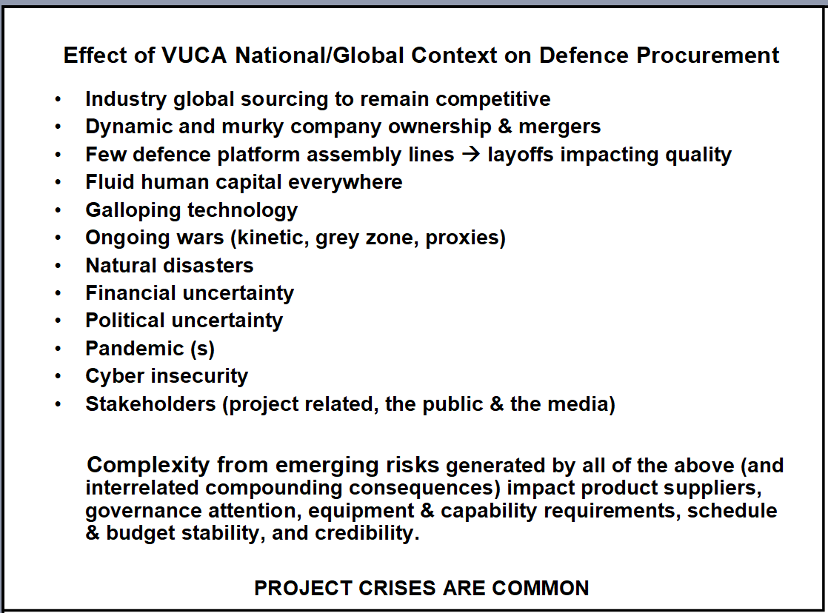
In hindsight, I likely should have added many more and weighted a few.
During a decade of advancing weapons systems platform acquisitions, I personally was involved in major project setbacks and crises as a result of legitimate changes to project requirements, a climate extreme event, failed Requests for Proposals, unproductive interference by a Minster’s staff member, supplier and key subcontractor conflicts over performance, a Treasury Board Secretariat official derailing progress after Deputy Ministers had casually otherwise agreed to our course of action, a company being selected after competitive trials that then delivered an unreliable platform requiring redesign, an Assistant Deputy Minister refusing to engage a very senior company official in joint governance for years, intense media scrutiny stalling a project based on flawed information, technology plans that were underestimated by the winning bidder – the list goes on. And such crises often cost one or more years of delay to important projects that the Canadian Armed Forces needed.
That is not to say that every major project issue leads to a dramatic project crisis. On the contrary, many are effectively and efficiently dealt with.
What I observed as the root cause of most project crises did not take rocket science to determine. As everyone knows who has experienced a significant interpersonal conflict with consequences lasting months or years, the emergent and challenging issue is not normally the cause of the crisis. It is most often the behaviour of the stakeholders involved.
All feelings are welcome, but not all behaviors are – Aliza Pressman
Those involved in such expensive and necessary weapons systems acquisitions are there because of their experience and positions of great responsibility in their respective organizations. They have been repeatedly promoted, hold strong opinions, are very busy and are humans with character flaws, biases and emotions. I say this with humility – I was one of them.
To avoid the potential risk of significant harm to desperately needed acquisition projects, three techniques to mitigate the potential damage of project crises are gaining considerable traction for navigating complex projects: stakeholder alignment maintenance, sustainable and structured collaboration and rapid risk response. And the first two are often avoided due to risk aversion.
Stakeholder Alignment Maintenance: Those with a significant stake in the project – directly or indirectly – typically have an outsized impact on project outcomes. When acquiring weapons systems platforms, those at senior levels have significant influence, rotate fairly frequently, rarely have enough time for formal project orientation, and follow related media and Ministerial/Board commentary closely. As representatives of different organizations, they are required to adopt the prevailing perspectives of their parent employer and/or boss, rather than their personal and often more insightful project opinions. And staff members misuse the authority of their leader based on personal opinions, in the absence of interest from their influential boss.
While stakeholders can withdraw project support at any time and for any reason, certain triggers are the cause of many support wobbles that can spread like airborne viruses to create crises, specifically negative media stories and engagement with others who have growing concerns.
A stakeholder alignment maintenance system is based on tracking stakeholders who are interested and/or influential in three prioritized categories, ranked from the most important to the least: the influential and interested, the influential and the merely interested.
Methods of remaining aware of stakeholder perspectives and those who may be transitioning categories need to be determined wherever possible to assess if risks may be developing. I found frequent informal chats about common interests with those guarding the offices of such ‘titans’ to be useful in that regard. For the most influential stakeholders, close allies of similar rank who are colleagues of questioning stakeholders can be helpful allies to make appointments and assess potential degrees of misalignment.
Once awareness is established, attempts to mitigate risks can be pursued. I found tailored briefings to broad stakeholder groups that include worrisome influencers to work best, based on ascertained facts and project courses of action in response. Such group discussions identified where there was a need for follow-on work intended to bring stakeholders in line, or to adapt project intentions to comply with valid stakeholder interventions. I also employed regular briefings to influential officials on project activity to be welcome information for them and intelligence gathering for me.
How this system is managed requires a deft hand. I have heard of such endeavours that were branded as everything from manipulative to clandestine spy craft. Repeated targeting of disgruntled influential stakeholders can be counterproductive by eliciting a project crisis. If records are kept by government officials, they could become public under Access to Information requests and be misunderstood. Risk aversion can kill such initiatives unless they are appropriately implemented.
One last note is essential. In pursuing such initiatives, project managers should never become passionate advocates for their projects because it can destroy their objectivity. It is the client’s end-user community that advocates, whereas project managers sense and address risks to approved project outcomes.
Sustainable and Structured Collaboration: I have written a more comprehensive paper on this subject that is published by the Policy Insights Forum (The Better Way to Engage Across the Contract Divide for Complex Projects, May 2024). Effective collaboration can be a powerful tool for all organized groups to deliver a multitude of benefits, especially for parties to a weapons systems platform procurement contract involving the government and a prime contractor.
The concept is based on joint side-by-side working, first raised in the UK before the turn of the century. There are various brands and approaches, in particular coming out of Britain, the U.S.A. and Canada. Each has strengths and weaknesses. Some focus on developing collaborative behaviours based on principles, whereas others establish process protocols to maintain joint alignment from the strategic to tactical levels.
Real collaboration occurs when all parties embrace ‘best for project’ as the priority. Relationships are critical to developing the trust needed for effective and reliable collaboration. But with trusting relationships, there must be compliance with the legally required responsibility of all parties to their employer’s direction at all times, based on a foundation of the legal definition or prudence in their conduct. Not surprisingly, the term ‘relationships’ can be problematic in a culture of risk aversion where contracting officials object to the encouragement of relationships across the contract divide, fearing contractual challenges when relations cross ‘no go’ lines.. My experience is that naysayers are looking for guardrails and a comprehensive joint risk management system to allay their fears.
In my view, there are two critical enablers that must be in place:
- All joint governance members at all levels must be ‘all in’, walking the collaboration talk and respecting the collaborative engagement protocols.
- Before the government engages the selected prime contractor in any formal contractual discussions, a collaborative workshop must be completed to establish the joint working processes and behavioural guidelines. This session should be provided by a joint Collaboration Support Office that should last the life of the project.
Once implemented properly and established across the entire project enterprise, issues get resolved jointly so as to avoid – and if necessary defuse – conflicts.
Finally and having studied the various international brands of collaboration consultancies, I am a fan of the Canadian approach of Strategic Relationships Solutions (SRS), based here in Ottawa, who I believe offer the must sustainable and meaningful joint collaborative environment that operationalizes collaborative relationships. This offers the best safeguards when project risks emerge to avoid them from spiraling into project crises. (For full disclosure, I am a past Executive Associate of SRS, a position I took because of my assessment of the company’s superior methodology)
Rapid Risk Response: Timely risk treatment is an ongoing and all-encompassing activity when early signals of potential concern are identified of anything going awry, as raised by anyone in the project enterprise.
However, some risks have more potential than others to do grave harm to project outcomes, and transitions by influential stakeholders into withdrawing their project support qualify for special treatment.
The joint and integrated risk management group requires something akin to a rapid risk response team:
- It should be led by the most experienced risk treatment expert and include the most open-minded systems thinkers from key project teams to conduct analyses, write exceptional briefing Decks and notes and develop clear public relations narratives.
- They must be able to assemble within hours (pagers still work well) or dial-in if necessary.
- Their purpose if to perform the standard risk treatment activities: identification, exploration, analysis, consequence scenario generation, treatment options for damage control and briefing preparation for decision-making by senior personnel.
- The difference is the focused dedication of effort and speed with which products must be delivered, often with parallel activity involving a dozen or so selected personnel.
- If practiced often, timely option selection and implementation can follow to minimize the potential damage of misaligned interested and influential stakeholders.
I admit that I have only seen such an approach employed very effectively by the federal government in Washington D.C. during my time at the Canadian Embassy, to deal with all manner of threats and disasters. During my tenure, with a portfolio pf weapons systems platform acquisition projects, this approach was occasionally applied more casually with a small team to develop a course of action for urgent implementation – sometimes to good effect, sometimes not. Nevertheless, I recommend that project managers insist on such a capability that can be practiced in slower time and applied when appropriate – for stakeholder realignment or any other suddenly emerging significant project risk.
To conclude, this trio of techniques would work best when pursued concurrently. They are risk treatment tools that should be in every platform acquisition execution team’s toolbox. They are not inexpensive or easy to create, and as previously mentioned, two of them come with a degree of risk. But when multi billion dollar weapons systems platforms are at stake, the return on investment is worth both the costs and risks.