

Recently, a report was released entitled ‘Defence Agile Procurement Insights and Analysis (DAPIA)’. Because I cannot do it justice in the few paragraphs that follow, I recommend reading the report. It may be important since I get the sense that it was part of the considerations in establishing the mandate statement and desired outcomes enunciated for the recently announced Defence Investment Agency (DIA) to be stood up this autumn.
It offers a procurement vehicle to enhance the ability of the government ‘to procure advanced solutions effectively through agile procurement methods’. The model developed ‘emphasizes flexibility, speed, and collaboration… agile procurement seeks to adapt and respond to changing needs and market conditions as a procurement project evolves’.
The model is described in brief as follows:
‘In the cyclical process of agile procurement, the contractor will initially develop a minimum viable product (MVP) and then apply iterative improvements until it delivers the final product. It is important to note that the MVP is not a prototype or mock-up. It is a fully functional, working, serviceable product with reduced capability. The end customer has the option of deploying the MVP, either in a trial setting or as a fielded product. In either case, the contractor will service the MVP while continuing to work on the product’s development, delivering incrementally evolved versions of the product in successive iterations.’
My sense is that the project is one of development to achieve a product that successfully enters service and is then continuously improved through design modifications to meet changing operational requirements and to avoid obsolescence. And once a supplier is selected, the implication is that competitions will not occur that would require the MVP+ to be proven as best in class.
A number of the attributes identified in the model are practices that are either intended for future employment under the Continuous Capability Sustainment initiative (as mentioned in the report) or are already in use internationally as emerging techniques to navigate complex projects.
This paper more broadly explores how contract award might be accelerated.
The Bureaucracy-Laden Maze
Below is a diagram that I developed during my DND tenure with a portfolio of complex weapon systems platform acquisition projects. The details are not the message, which likely have changed since 2015. The overall picture makes the point well in terms of committees (above the line) and documents (below the line) required in 2015.

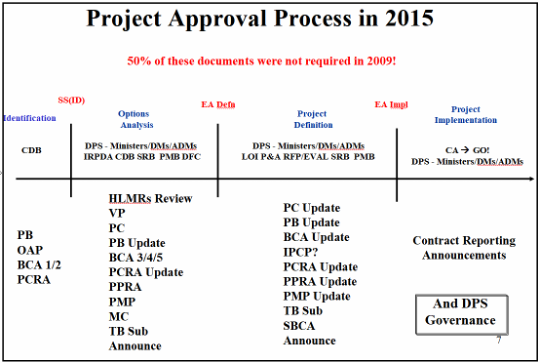
What has not changed are the steps to reach initial contract award: mustering the capable project personnel for various required functions, defining and achieving approval of the user requirements, engaging industry, developing a Request for Proposals and applying some competitive or non-competitive procurement mechanism to select one or more suppliers for contract award. The procurement mechanism and subsequent contract must be fit-for-purpose to achieve the desired and effective outcomes from industry, both during implementation and once in service for decades.
The definitions of agility in the Cambridge dictionary include ‘quick and easy’ and ‘ways of doing work in which changes are made as they are needed’. DAPIA certainly qualified for the latter of the two definitions. And looking at the DIA’s desired outcomes, the purpose of agility is to quickly complete procurement tasks.
Because the software in all products tends to be more agile by its nature than the physical aspects, this paper focuses on the latter.
Personnel
It is not a cliché – it is indeed always about the people. In complex acquisitions, having the right knowledge, skills, experience and culture in sufficient numbers is ever more critical than in less challenging procurements. And getting the right team in place as the project enters the Project Initiation phase – as implied in the DIA mandate – is an essential enabler of a successful and effective result for the CAF.
Agility here requires a pipeline of qualified personnel, in the Public Service and the CAF or from tailored and standing contracts – for individuals or for an entire project execution team.
Within DND and beyond the requirements team members, CAF members can fill critical gaps but they rarely have experience of adequate depth. Although quick learners, they are still largely engaged in on-job training and normally posted elsewhere within 2 years. In PSPC, senior contract managers are sometimes reluctant to accept a potentially career-limiting and lengthy complex DND procurement job, opting instead for less challenging positions for the same pay.
I believe that people is the most difficult barrier to procurement agility. In the case of the DIA, additional concerns exist as it stands up. People will be drawn from various organizations to be molded into new teams. There are presently shortages across government of such qualified people to draw from. And the new teams must embrace a much less risk-averse culture. We should therefore expect this transformation to outlast the first CEO of the DIA.
Statement of Requirements
The DAPIA report offers a viable and agile solution to the requirements task by focusing on the high level mandatory requirements (HLMRs, the most important attributes to achieve the assigned mission set) alone, to take to industry. DAPIA also suggests that the requirement set evolves with threat development until the MVP+ is accepted – such changes in requirements done in collaboration with the client via contract amendments. And although not mentioned in the DAPIA report at acceptance by the client, healthy design margins for such things as electrical power, space and weight are essential to enable in-service updates if the product is to be fitted on a weapons systems platform.
Three items remain of potential concern to generating and updating the product capabilities:
- Appropriately, those who develop the HLMRs must be sourced from the service client in the CAF. However, they suffer from the same issues mentioned earlier for CAF members’ capabilities and rotational postings.
- Because the CAF in the past has been limited to one product design where larger militaries field many for a capability sector, the right HLMRs are essential and can become a long list that few commercial companies can easily deliver in a single product.
- Requirements creep is built into the DAPIA solution to address evolving threats, a characteristic that achieves agility in operational readiness but at the cost of both more funds and a less timely fielding of a MVP+.
For a DAPIA procurement vehicle or otherwise, more agility can be created to deal with the CAF member challenge by posting those in uniform into an Operational Authorization Cell with a mandate to provide advice regarding requirements. These CAF members should be separate from those developing the actual requirements documents who would be long-in-the-tooth experienced civilians to do the heavy lifting.
Regarding the second issue and noting that more funds should be available as Canada targets 5% of GDP for military purposes by 2035, multiple product designs are a useful option, whether crewed or not and assuming that the personnel to operate, acquire and support them are available.
Requirements creep is unlikely to be a budget challenge for the same reason just enunciated. However, when to field is all about the judgment of the client, and the trade-off between the improvements in operational agility with changed requirements in a MVP+, and the additional operational capabilities achieved earlier by fielding a MPV. And given that the tactical use of an earlier version against threats is to some extent a choice by commanders, this can mitigate such concerns. But there can be no doubt that requirements creep is a significant risk to the DAPIA proposal.
One additional requirement change is recommended. Since DIA reports to the PSPC Secretary of State and is in charge of the acquisition of weapons systems platforms – a departure the global approach of the client department having total responsible – it makes sense that every project managed by the DIA have an Operational Requirements Cell embedded in the project execution office and reporting to the CAF client service.
Engaging Industry
Efforts have been made in the past decade to formally publish planning documents on product acquisition intentions, but these remained aspirations rather than commitments. To change this channel, a more agile procurement system must include more timely government decisions to launch projects as planned, the availability of the people to do so effectively, service level agreement in place and satisfied by stakeholder organizations, and continual transparency in terms of updates.
Requests for Proposals (RFPs)
Regardless of the procurement mechanism employed, an RFP is always required. These identify the general and specific terms and conditions of the contract, which normally include the following major elements from memory: technical production standards to be met, technical details of the product, methods for tracking performance and payment, travel and other allowances, liability, security, data transfer, intellectual property, warranties, trials, training, commissioning, bid evaluation and bid response details.
Not practiced in the past to my knowledge, RFPs should be based on a minimum of mandatory requirements beyond HLMRs, with all other items prioritized. Furthermore, they should be subjected to a Red Team Review by a board comprised of external personnel with related industry sector experience, such board with the authority to remove items of lesser importance and/or that can be installed after acquisition as upgrades.
Procurement Vehicles
For decades, Canada has had an array of methods to procure a preferred supplier. Among these are competition, sole source, Advanced Contract Award Notice, unsolicited proposals, product development, government-to-government, commodity-specific arrangements and leasing. And there have been hybrid procurement methods employed as well.
Agility argues for vehicle selection with shorter time frames to complete. I would argue that one more vehicle should be added: “make me an offer and let’s see if we can shape a deal”. After all, the evolution of a system to hire transport aircraft for urgent requirements within days (and sometimes hours) has been in place for decades. As well, the DAPIA report offers another proposed procurement vehicle to consider, though perhaps not a candidate for speed.
So What
The DIA mandate appears to mandate agility/speed, so it matters.
Weapons systems platform acquisitions are well known for being ponderous, lethargic and disabled beasts. And yet, it is well known that the process has been completed in months when urgency is required, as dictated by urgent contingency operations for the CAF. The trick is to advance all major procurements equally as agile as the default expectation. Acceptance of the related additional risks must become the norm, such concerns tracked and addressed. If need be, failed procurements should be openly admitted as the cost of doing business and absent any recrimination.
But then, progress is about taking risks and treating them. That is already the job, isn’t it?