
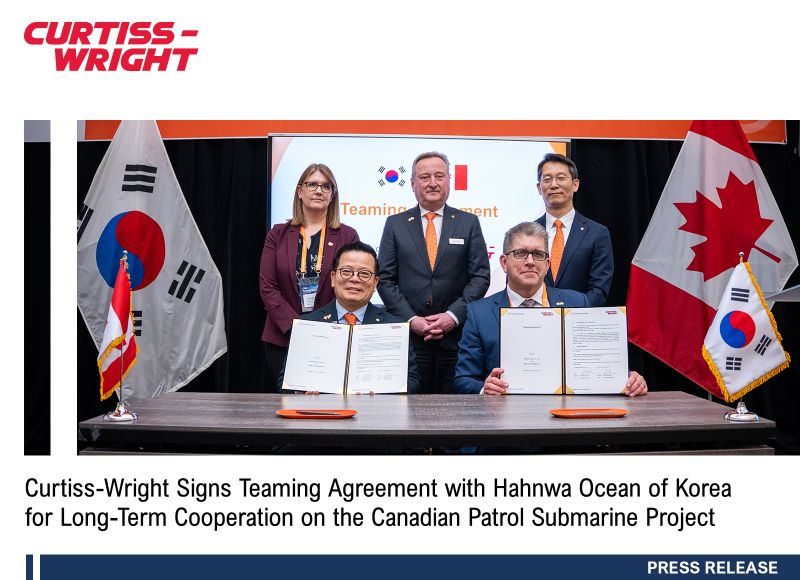
As Canada’s Canadian Patrol Submarine Project (CPSP) continues to take shape, new industrial partnerships are emerging that signal both capability readiness and long-term economic intent. The latest comes from Curtiss-Wright and Hanwha Ocean of Korea, who have formalized a Teaming Agreement focused on delivering critical systems for the KSS-III submarine—one of the platforms positioned to meet Canada’s evolving undersea requirements.
At the centre of the agreement is Curtiss-Wright’s Towed Array Handling Systems, a key component of modern submarine operations. These systems, which enable the deployment and retrieval of undersea sensor arrays, will support KSS-III submarines proposed for the Royal Canadian Navy. The work will be carried out by Curtiss-Wright Electro-Mechanical Systems in Mississauga, Ontario—placing advanced manufacturing and engineering activity squarely within Canada’s industrial base.
Curtiss-Wright brings more than a decade of direct experience with the KSS-III platform, having supplied these systems to the Republic of Korea Navy since 2011. The submarine itself is already in service and recognized as a capable ocean-going, diesel-electric platform—attributes that align with Canada’s operational requirements and the program’s accelerated delivery timelines.
The agreement also reinforces Curtiss-Wright’s broader role as a global supplier of naval systems, spanning helicopter handling systems, undersea sensor deployment technologies, and ship aviation support systems. Its footprint extends across major naval programs in the United States, Canada, Japan, Italy, Australia, Chile, India, Singapore, Spain, and Turkey—positioning the company as a proven partner in multinational defence efforts.
For Curtiss-Wright, the partnership is as much about industrial growth in Canada as it is about platform capability.
“We are proud to further our partnership with Hanwha Ocean through this Teaming Agreement. Leveraging our long-proven Canadian expertise in complex systems integration and advanced handling equipment, we are pleased to support next-generation submarine systems with international partners, expanding high-value engineering and manufacturing work in Mississauga while developing Canada’s broader defense industrial capacity,” said David Micha, Sr. Vice President & General Manager, Curtiss-Wright Electro-Mechanical Systems.
Hanwha Ocean, which has been actively building relationships across Canada’s marine and defence sectors, framed the agreement as part of a wider strategy to embed long-term industrial value within the country.
“These partnerships reflect our long-term commitment to working alongside Canadian industry to deliver meaningful and lasting value. By partnering with leading Canadian companies across critical capability areas, we are not only strengthening Canada’s defense industrial base, but also supporting innovation, advanced manufacturing, and the development of a highly skilled workforce. We see this as part of a broader effort to contribute to Canada’s long-term economic growth and sovereign defense capability, aligned with the country’s national priorities,” stated Glenn Copeland, CEO, Hanwha Defence Canada.
As CPSP progresses, partnerships like this one illustrate a broader trend: capability decisions are increasingly inseparable from industrial strategy. In this case, the alignment between an in-service submarine platform and a Canadian-based supply chain partner underscores a dual focus on operational readiness and domestic economic impact—both of which will be central to Canada’s next-generation submarine fleet.