
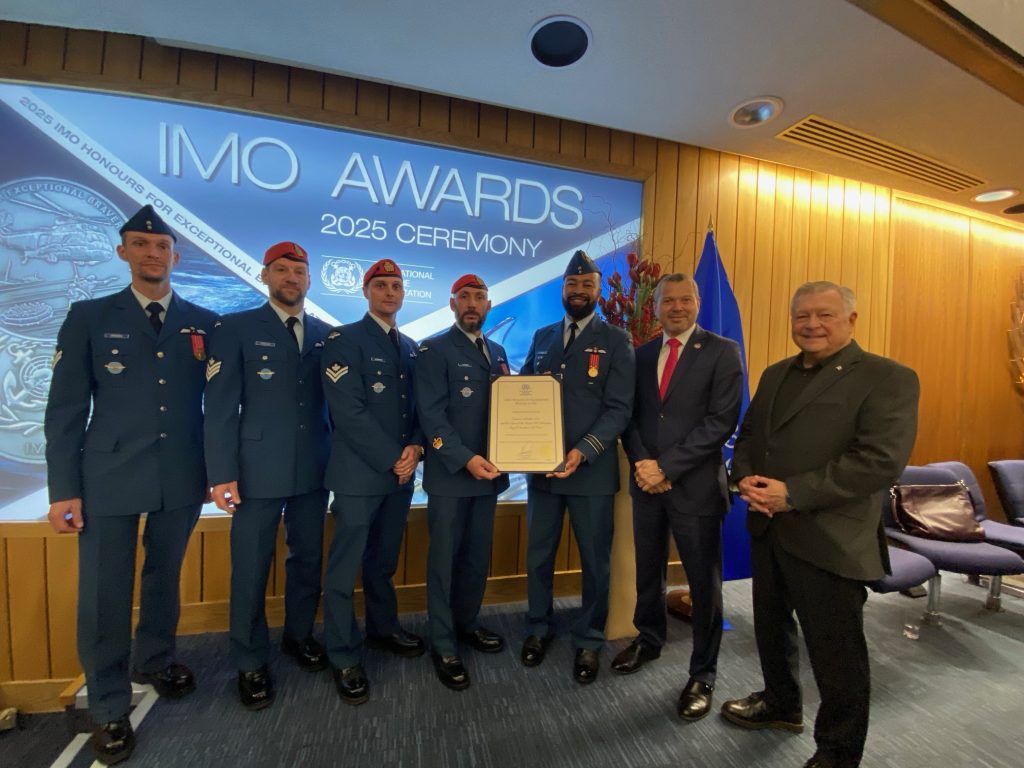
When the International Maritime Organization (IMO) gathered in London this November to honour extraordinary acts of courage at sea, the spotlight turned to a Canadian crew whose actions earlier this year redefined the limits of resolve under pressure. On November 24, 2025, members of 103 Search and Rescue Squadron were awarded a Certificate of Commendation for Exceptional Bravery at Sea, formal recognition of a mission that pushed the boundaries of skill, endurance, and teamwork.
Their feat unfolded on February 15, 2025, off the rugged coast near Lark Harbour, Newfoundland. That morning, the cargo vessel MSC Baltic III was battling chaotic seas, its upper deck coated in ice, its crew urgently signalling for help. Heavy winds—blowing over 75 kilometres per hour—collided with towering five-metre waves, creating one of the most treacherous marine environments Canadian rescuers had encountered in years. With 20 mariners aboard, including four seriously injured, time was running out.
A Crew Built for the Impossible
From Gander, a CH-149 Cormorant helicopter—call sign Rescue 901 (R901)—lifted into the storm. Its crew included aircraft commander Captain Matthew Cox, first officer Major Pete Wright, flight engineer Master Corporal Todd Osmond, and Search and Rescue Technicians Warrant Officer Gregory Hudson, Sergeant Sebastian Gaudet, Master Corporal Gary Normore, and Sergeant Alain Goguen. Together, they formed a team forged by countless hours of joint training and real-world operations across Canada’s vast and unforgiving search and rescue regions.
Their cohesion would be tested almost immediately. As R901 approached the scene, the MSC Baltic III showed signs of rapid deterioration, its deck completely iced over and its motion unpredictable. A standard hoist was still possible—but only barely, and not for long.
Yet the crew pressed forward, embodying what Lieutenant-General Steve Boivin would later describe as the unwavering spirit of Canadian SAR operators:
“I am proud of the accomplishments of Rescue 901 from 103 Search and Rescue Squadron. The team displayed tremendous courage, tenacity, and technical expertise during this rescue, embodying the very best of who we are as Canadian Armed Forces members. The international recognition of our search and rescue team highlights the excellence and precision that our search and rescue operations demand to save lives under the most challenging circumstances.”
Sixty Minutes of Precision Under Peril
The rescue window was shrinking. Once the crew determined the vessel’s structural integrity was worsening, they made a critical decision: every one of the 20 mariners would need to be hoisted off immediately.
The next hour unfolded like a masterclass in coordinated crisis response. Battling relentless winds and waves, SAR technicians cycled continuously between the churning deck and the hovering helicopter. Inside the aircraft, the crew worked with laser-focused synchronization—managing injuries, maintaining aircraft stability, and coordinating each hoist with near-perfect timing.
The danger was constant. The hovering helicopter fought to remain steady; the technicians worked inches from breaking seas; the ship rolled unpredictably beneath them. Yet the team never faltered. In just 60 minutes, all 20 crew members—injured, exhausted, or clinging to whatever safety the failing vessel could still provide—were airlifted to safety.
Lieutenant-General Jamie Speiser-Blanchet, Commander of the Royal Canadian Air Force, captured the significance of their achievement:
“The actions of Rescue 901 exemplify the courage, professionalism, and unwavering commitment that define the Royal Canadian Air Force. Faced with extreme conditions and immense risk, this crew demonstrated exceptional skill and determination to save lives. Their recognition by the International Maritime Organization is a testament not only to their bravery but to the world-class search and rescue capability Canada provides every day. I could not be prouder of these individuals and the standard they set for all of us.”
A Moment of International Recognition—and Community Pride
For 9 Wing Gander, home to 103 Squadron, the commendation represents more than a medal. It affirms the Wing’s central role in safeguarding mariners across the North Atlantic and showcases the human stories behind missions often executed far from public view.
Lieutenant-Colonel Bob Mitchell, Wing Commander, reflected on the accomplishment:
“On behalf of everyone at 9 Wing Gander, I extend my deepest congratulations to the crew of Rescue 901 for their extraordinary courage and professionalism during the rescue of the MSC Baltic III on February 15, 2025.
Faced with extreme weather, high seas, and a rapidly deteriorating vessel, this crew demonstrated the highest standards of skill, determination, and teamwork. Their actions under such perilous conditions reflect not only their individual bravery but the steadfast commitment of every member of 103 Search and Rescue Squadron to the preservation of life at sea.
This international recognition, by the International Maritime Organization, is a proud moment for the entire Wing and for the community of Gander. It underscores the vital role our search and rescue crews play—often at great personal risk—in safeguarding mariners across the North Atlantic.”
The commendation from the IMO now stands as a formal testament to an operation already etched into Canadian SAR history—a rescue that demanded everything from the crew aboard R901, and one that showed the world the unwavering grit and professionalism of Canada’s search and rescue community.