
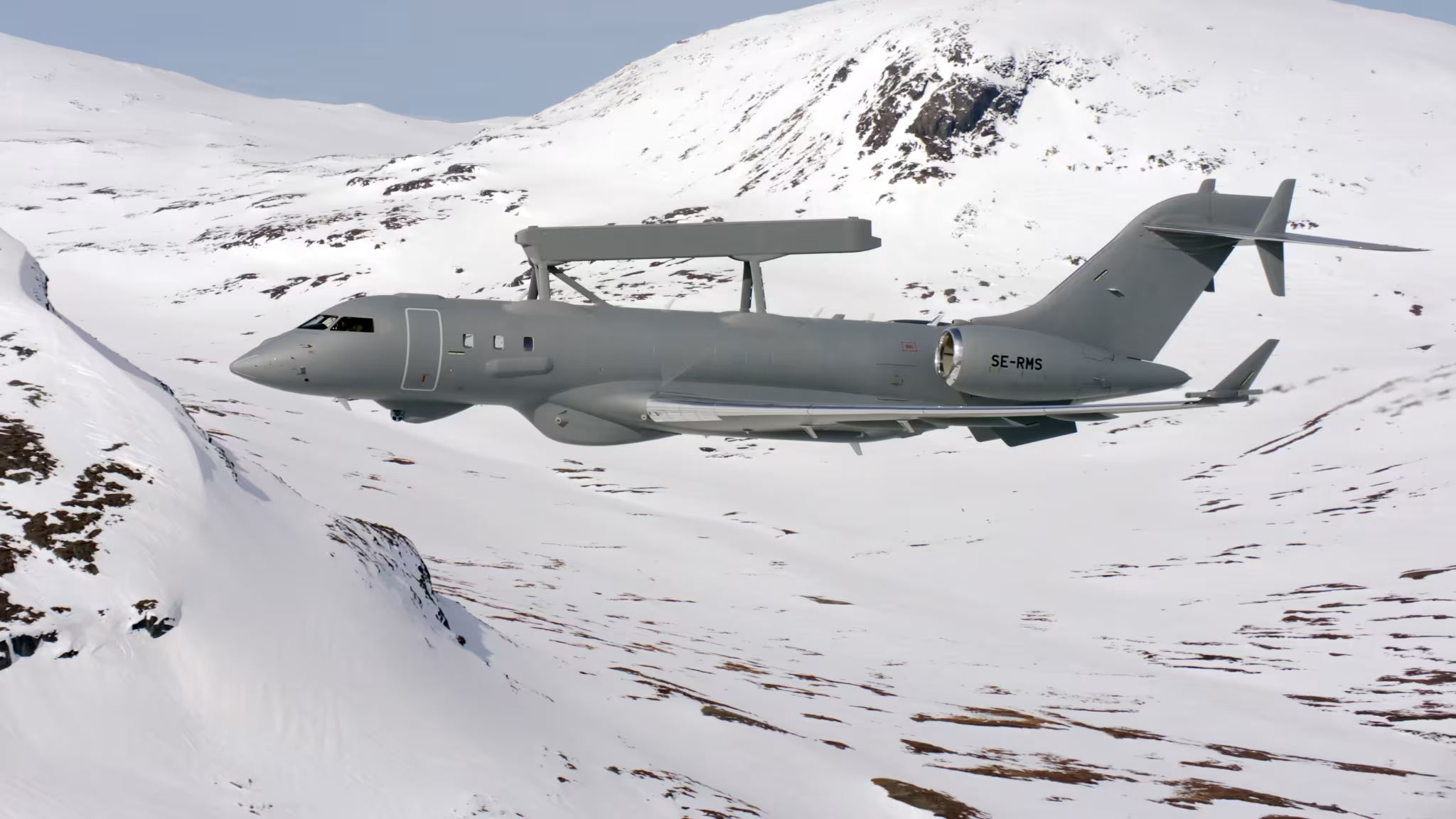
Prime Minister Mark Carney made a personal appearance at CANSEC in Ottawa on May 27 to announce that the federal government has selected Saab of Sweden as its preferred supplier for the Airborne Early Warning and Control (AEWC) program, opening the door to formal discussions on a deal that could bring advanced multi-domain surveillance to the Royal Canadian Air Force.
The initiative is being led by the Defence Investment Agency under the Honourable Stephen Fuhr, Secretary of State (Defence Procurement). The selection does not constitute a procurement commitment. What it does is move Canada into a negotiation lane with a supplier and a platform.
The platform
Saab’s proposed solution is the GlobalEye, built on the Canadian-manufactured Bombardier Global 6500 aircraft. That’s a meaningful detail. The airframe is made in Canada, which positions GlobalEye as something more than a foreign import. The government says the arrangement is expected to support domestic production, highly skilled jobs, technology transfer, and partnerships with Canadian industry.
The AEWC capability would give the RCAF advanced airborne command, control, and surveillance tools to detect, track, and respond to threats at long range, including in the Arctic. For a country trying to demonstrate renewed seriousness about NORAD modernisation and Arctic sovereignty, that framing is deliberate.
CAE joins the team
The same day Ottawa named Saab its preferred supplier, Saab announced it had signed a teaming agreement with CAE to pursue the Canadian program together.
The agreement builds on a Global Cooperation Agreement between Saab and CAE announced in November 2025, and is intended to deepen their collaboration and broaden the scope of cooperation across training and simulation.
Through the partnership, Saab aims to integrate CAE’s expertise in training to deliver fully integrated and scalable training and simulation solutions for the Canadian Armed Forces. CAE, headquartered in Montreal, brings decades of defence simulation and training experience and an existing footprint inside the Canadian defence establishment.
Saab President and CEO Micael Johansson said GlobalEye delivers long-range detection and advanced situational awareness across air, maritime, and land domains, and described the Canadian program as a stepping stone for future opportunities.
CAE CEO Matt Bromberg called the agreement a reflection of the two companies’ shared commitment to delivering innovative, integrated solutions that strengthen Canada’s defence priorities.
Industrial angle
The government has been deliberate in framing AEWC as an industrial opportunity, not just a capability purchase. The project is expected to generate long-term economic opportunities through Canada-based missionization work, technology integration, workforce development, and potential participation in global defence supply chains.
DIA CEO Doug Guzman said the initiative would help build the sovereign industrial capacity and technological expertise needed to support Canada’s security and economic resilience over the long term.
That language tracks with Canada’s Defence Industrial Strategy and the BUILD-PARTNER-BUY framework, which prioritises domestic industrial benefit alongside operational capability.
What comes next
The Defence Investment Agency will lead further engagement with Saab in the coming weeks to explore commercial, technical, and economic considerations. No timeline for a contract has been announced.
With a preferred supplier now named and an industrial team taking shape, the program moves from concept into the hard work of negotiation.