

The reader may remember when Mark Carney laid out his defence procurement reform intentions, as reported by CBC’s Murray Brewster on 14 April 2025. Then a Liberal leadership candidate, he stated that a Liberal government would modernize procurement rules and amend legislation and regulations as required to “centralize expertise from across government and streamline the way we buy equipment for the military.”
Subsequent to his election as Prime Minister (PM), he indicated that he was serious about the subject by creating a sort of committee of Ministers.

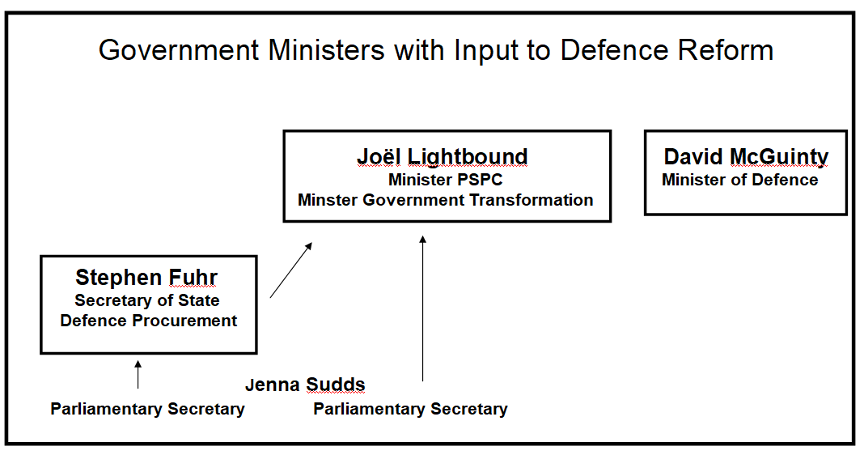
The PM’s Mandate Letter offered no further insights. Nevertheless, we might assume that he has tasked the Minister of Transformation, Public Works and Procurement with modernizing procurement rules, centralizing the related expertise from across government and streamlining the way we buy equipment for the military, all to focus more on results than on process.
In terms of centralizing expertise, the term Defence Procurement Agency has not been officially recycled as far as I know, nor should it be – procuring is only one function of acquisition. As a placeholder, I have employed the term ‘centralized expertise entity’ (CEE) in this note.
Many questions immediately come to mind: Will the CEE be absorbed into PSPC or the Department of National Defence (DND)? Will it be a new and separate organization? Will the CEE only be responsible for weapons systems platform acquisition projects, those expensive, routinely late to need and over-budget projects that elicit the comment “military procurement is broken”?
Whoops, big mistake jumping to conclusions about where the CEE should be home-ported, before we know anything about the HMCS CEE (e.g. her length, beam and draught, her shore power requirements). Only then would we be able to define the functions required in home-porting.
In a CGAI article published in late August 2025, Vice-Admiral (Ret’d) Ron Lloyd highlighted that ‘form follows function’ – a quote attributed to the architect Louis H. Sullivan over a century ago. He further argued that applying the principle was essential when considering organizational changes affecting DND.
So let’s explore a set of functional requirements based on a two fundamental assumptions regarding mission statements:
- For the government in terms of military acquisition projects: to give industry a reasonable chance of being successful in delivering functionally effective weapons/systems required by the CAF and at a decent profit, while ensuring prudent oversight based on prior developed judgment.
- For the CEE: to deliver weapons systems platform acquisition projects to meet the needs of the CAF in terms of timing and effectiveness.
But military procurement is widely perceived as broken. If true in whole or in part, this argues for the development of a list of functions that need to be included but only in an improved state. This is a list that is well known to most observers.
Below is a list of functions and selected methods to achieve improved project outcomes. Note that the methods mentioned are candidates for trial to confirm value. They are certainly not exhaustive and only provided in shorthand. From Ron Lloyd’s perspective, these are potential candidates for the wiring and plumbing of small ‘p’ policies, practices and processes that need attention:
Cultural Transformation:
Not only must the CEE stand up with a new culture, but so too with each platform project. We know that means a special breed of leaders at all levels, walking the talk and behaving in alignment to key values.
The base culture to be created is one where mindsets, eyes and ears are open, all eyes are on the prize (the next goal) and all leaders are acting like snowplows to anticipate and quickly move aside the barriers to progress.
More broadly, all the following functions need to be integrated into the culture as enabling principles for alignment.
Reduced Risk Aversion:
Implement this cultural change, informed by success elsewhere as addressed in a Policy Insights Forum paper published in February 2025.
Leaders encourage greater risk acceptance and provide a safe space when things go awry.
Implement an advanced risk treatment system in all projects, to include treating moderate-to-high-risk decisions, to enable timely remediation and damage control when necessary.
Employ transparency with the media and the public to explain why heightened risks are being taken and the remedial action being pursued when/if such risks are realized.
Improved Accountability:
Assign a Minister and Deputy Minister to the CEE.
Insist on modified RAACI diagrams in all project charters to make accountabilities clear: who is responsible for each activity; who is accountable overall and with what authorities; and those who must be consulted and informed.
Create a deadlock resolution protocol at the Deputy Minister level, both within the CEE and with other government stakeholders.
Develop and enforce Service Level Agreements both within the CEE and with other involved government entities.
Timely Contract Awards:
- Start projects much earlier.
- Fund full project management offices before project initiation.
- Immediately implement and leverage the Continuous Capability Sustainment program (CCS) to maintain current statements of requirements, to facilitate the early launch of follow-on weapons systems platform replacement acquisitions.
- Employ big-tent ‘swarming’ events of all stakeholders to uncover and treat risks quickly at key acquisition system gates.
- Employ the deadlock resolution protocol mentioned above with urgency.
- Implement the next four functions on this list.
- Less Mandatory Policies, Processes and Contract Terms and Conditions:
- Conduct business process reengineering, with significant defence industry participation.
- Reduce ‘complexity debt’ by creating lean policies, processes and contractual Terms and Conditions (e.g. minimal ‘thou shall’ directives, supported by listed optional considerations).
- Require the CEE Deputy Minister’s approval to add to lean directives, as results are measured and to drive adaptation.
Better Government Stakeholder Collaboration and Reduced Project Crises:
- Require all project managers to implement a stakeholder alignment maintenance program.
- Implement a best-in-class sustainable collaboration system for government stakeholders at all levels.
- Where power imbalances among key stakeholder groups become prevalent, employ the DM-level deadlock resolution protocol mentioned above to restore equitable empowerment.
- Employ a rapid risk response capability to minimize the harm of misaligned stakeholders – as well as for other sudden sources of significant risk.
Credible Budget Announcements:
- Build on wave planning to announce budgets to reach project incremental goals, delaying full project cost announcements until well into implementation when costs are bottom-up and fact based.
- Employ briefings to the media and public to create acceptance of this approach.
Improving Stakeholders’ Understanding of Project Success:
- Employ transparent briefings to explain why the priority is delivering operations and support effectiveness for platforms, as enabled by effective government execution teams and while tracking efficiency measures.
CEE Governance:
- Members complete comprehensive CEE systems and project-specific orientation before contributing to project governance.
- Ensure access to knowledge relevant to each project’s industrial sector.
- Assign a member of senior governance to be responsible for all aspects of each project’s advanced risk treatment – the system and the emerging issues.
- Members practice servant leadership, not just oversight.
- Members dedicate whatever time is needed.
- Senior governance welcomes periodic reviews by external experts and seriously considers recommendations for performance improvements in their governance practices.
Enhanced Innovation:
- Significantly increase funding for innovation.
- Leverage reduced risk aversion.
- Enhance international collaborative research and development.
- Sole source Canadian systems reaching high technical readiness levels.
- Provide seed funding to Canadian manufacturers of equipment employed by the CAF, this to enable the incorporation of new technologies as potential follow-on replacement systems to avoid obsolescence.
Enhanced Transparency:
- Employ regular briefings to the media and public on all platform projects (status of progress to next goal, problems addressed since last briefing, problems now emerging with intended remediation and next beefing date).
Personnel Development:
- Dramatically increase available and competent officials and staff members in the CEE and in the Treasury Board Secretariat.
- Resolve the deficit of knowledge and experience with business acumen via Interchange Canada and with emerging techniques for complex projects by considering the Department of National Defence’s competency development program, Telfer’s education options, stand-up of a dedicated academy and creation of a complex project management Public Service occupational group.
- Include Treasury Board Secretariat personnel in complex project competency development.
- Create a well resourced CEE complex project support office to ensure that emerging practices are analyzed, trialed and supported if found to be of potential value in appropriate projects,
- Where capacity and competence are not available within government, employ contracted advice as a stop-gap measure.
Notice that although the significant function of procurement is not featured, notwithstanding its role in the government’s acquisition process. Aside from my belief that the tools to speed up procurement already exist (as recently seen in action with the Canadian Patrol Submarine Project), I will leave that subject to Canada’s defence industries to address with government.
As a final perspective, I note that the universal ‘form’ for such CEE’s is leadership by the client who is accountable to Heads of Government and Boards of Directors. The propensity to compromise regularly leads to less effective decisions which impact the project’s outcomes – in this case that could cost the lives of CAF members. If DND is not selected to lead the CEE, it should be a conscious and logical decision to ignore global wisdom and to perpetuate the ‘form follows past precedent’ principle, with acceptance of potentially unwanted impacts spilling over into the effectiveness of attempts to reform troublesome functions that could perpetuate the unwanted status quo.
If my assumptions in this paper regarding a reform agenda are correct, I strongly encourage the Ministers charged with “reforming and re-forming” problematic aspects of military acquisition to address this set of functions as a minimum before deciding on key aspects of a CEE. Let’s make Louis Sullivan proud.
Author’s Note – Readers are welcome to contact me at ian.mack.9@gmail.com if they wish to access copies of my papers or discuss aspects raised in this note.