
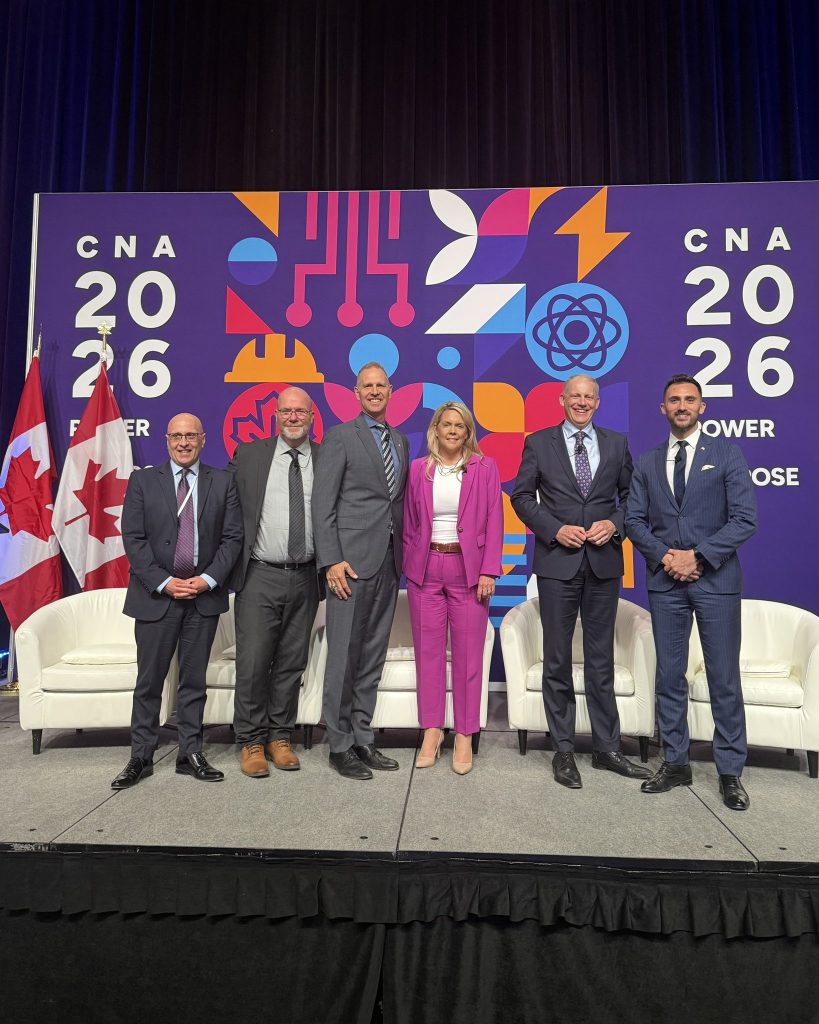
Canada is moving to redefine the role of nuclear energy in its economic and security future, positioning the sector at the centre of a broader push toward energy sovereignty, industrial growth, and national resilience.
At the Canadian Nuclear Association Conference, the Honourable Tim Hodgson announced that Natural Resources Canada is developing a new Nuclear Energy Strategy for Canada, set for release by the end of 2026. The plan aims to build on decades of domestic expertise while responding to a rapidly shifting global energy landscape.
“Canada has long been a nuclear leader — but we will not remain one by standing still. Our government is moving at speeds not seen in generations to get big things done, and nuclear energy is no exception. We must move urgently and strategically to remain at the forefront of innovation, working shoulder to shoulder with key partners to bring clean electricity, affordable bills and economic growth and security to all Canadians,” expressed the Honourable Tim Hodgson, Minister of Energy and Natural Resources.
The strategy draws heavily on Canada’s established strengths: its CANDU reactor technology, significant uranium reserves, highly skilled workforce, and globally respected safety framework. Together, these assets underpin a sector that Ottawa sees as critical not only for domestic energy security, but also for capturing a share of a global nuclear market projected to grow by up to $200 billion annually by 2030.
Structured around four pillars—new builds, global exports, expanded uranium production, and next-generation innovation—the strategy is designed to scale Canadian capabilities while strengthening partnerships with provinces, territories, Indigenous communities, industry, and labour. The goal is clear: deliver reliable, affordable, and clean electricity while unlocking trade diversification and long-term economic growth.
Beyond industrial ambitions, the strategy also carries a strong national security dimension. In parallel with the broader policy development, the Government of Canada is advancing targeted investments to explore how nuclear technologies can support defence operations in some of the country’s most challenging environments.
On behalf of the Honourable David J. McGuinty, Minister Hodgson announced an initial $40-million investment through Department of National Defence for 2026–2027. The funding will assess the feasibility of a Canadian-controlled microreactor capable of providing heat and electricity to remote and northern Canadian Armed Forces facilities.
“In the ever-evolving global threat landscape, Canada must strengthen its domestic capabilities to defend our interests, secure our sovereignty and shape our future. This feasibility program is an important step in supporting Canadian-controlled nuclear energy technology and enabling a sustained defence presence in the Arctic and the North,” stated the Honourable David J. McGuinty, Minister of National Defence.
The investment reflects a growing recognition that energy infrastructure is inseparable from operational readiness—particularly in the Arctic, where logistics, climate, and distance pose persistent challenges.
At the foundation of this strategy is a renewed commitment to science and innovation. The federal government has earmarked $2.2 billion over ten years for capital investments at Chalk River Laboratories, including the development of an Advanced Materials Research Centre and modernization of key infrastructure. These upgrades will consolidate legacy facilities into a next-generation research complex, enabling continued leadership in reactor development, safety and security, fuel innovation, and life-extension programs.
As Canada looks ahead, the message is unmistakable: nuclear energy is no longer just part of the country’s energy mix—it is becoming a central pillar of its economic strategy, defence posture, and technological ambition.