
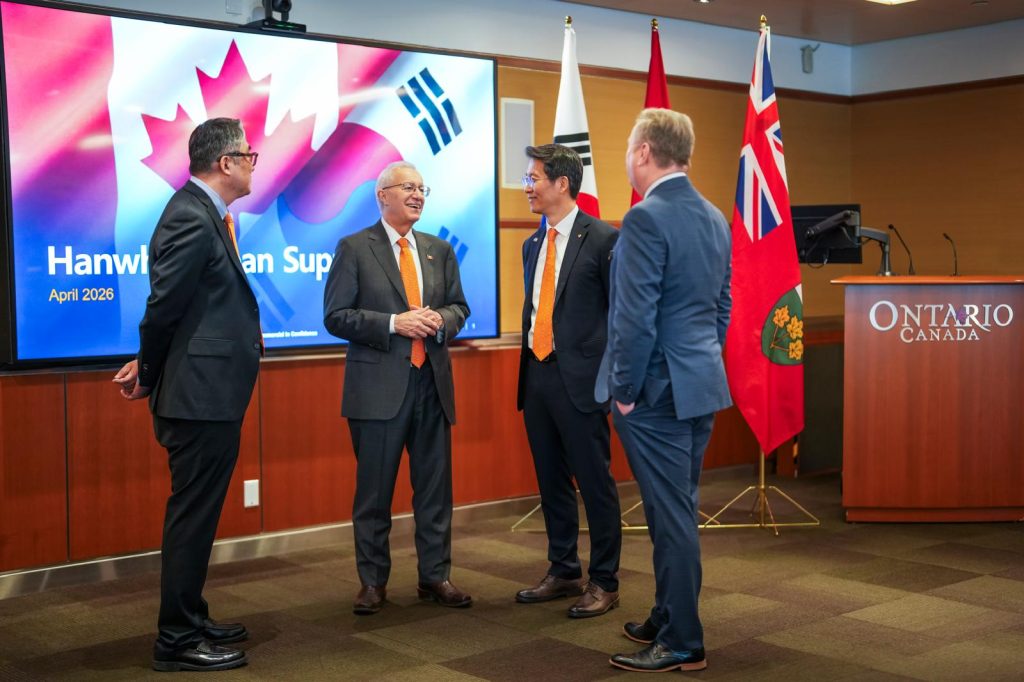
A Toronto industry day brought Korea’s Hanwha Ocean face-to-face with Ontario suppliers, marking one of the most concrete steps yet in Canada’s submarine industrial build-up.
Canada released its first Defence Industrial Strategy in February. On April 16, Ontario offered a glimpse of what implementation looks like at the provincial level.
The Government of Ontario’s Ministry of Economic Development, Job Creation and Trade hosted an industry and suppliers day in Toronto, bringing Hanwha Ocean, Hanwha Systems, and LIG Nex1 Defense and Aerospace together with Ontario companies and academic institutions for more than 50 business-to-business meetings.
Where the program stands
The Canadian Patrol Submarine Project (CPSP) is at a critical juncture. Two qualified suppliers, Thyssen Krupp Marine Systems and Hanwha Ocean, were identified in August 2025. Proposal instructions were issued in November 2025, with a submission deadline of March 2, 2026. Both proposals are now under government review. The Defence Investment Agency has indicated a preferred supplier decision could come as early as summer 2026.
The program’s scope is significant. The RCN requires up to 12 conventionally powered submarines, with the first vessel to be delivered no later than 2035 to avoid a capability gap as the Victoria-class fleet reaches the end of its service life in the mid-to-late 2030s.
In March, the DIA launched a separate Request for Information to engage Canadian industry on sustainment of the future fleet. The government has been explicit that sustainment activities will be conducted in Canada, in or near homeports, supported by a national supply chain.
Formalizing the industrial picture
The April 16 event built on commitments Hanwha has been accumulating across Ontario. The company announced a teaming agreement with Ontario Shipyards covering large-scale shipbuilding capability and a training hub in partnership with Mohawk College. A separate MOU with Algoma Steel targets the use of Canadian-produced steel in future naval programs.
“Canadian content is not an afterthought in our CPSP approach — it is the foundation,” said Glenn Copeland, CEO of Hanwha Defence Canada. “We have made firm commitments on workforce development, technology transfer, and in-country sustainment.”
Steve SK Jeong, Senior Executive Vice President and Head of Naval Ship International Business at Hanwha Ocean, framed the company’s Ontario presence as a listening exercise as much as a sales effort. “We are here to learn about Ontario’s capabilities, to identify where our programs can be strengthened by Canadian innovation, and to begin the long-term relationships that a multi-decade submarine enterprise requires.”
Aligned with the DIS
The approach maps directly onto Canada’s Defence Industrial Strategy, which frames major procurement programs as tools for building domestic capability rather than simply acquiring platforms. The DIA has described the CPSP as part of the first wave of high-priority defence procurements transferred to the agency, with the goal of accelerating delivery while maximizing Canadian industrial participation. Hanwha says it now holds teaming agreements and MOUs with more than 30 Canadian companies nationwide.
A preferred supplier decision is expected by summer. On April 16, Ontario companies got their first direct look at what a multi-decade submarine enterprise could mean for their businesses.