
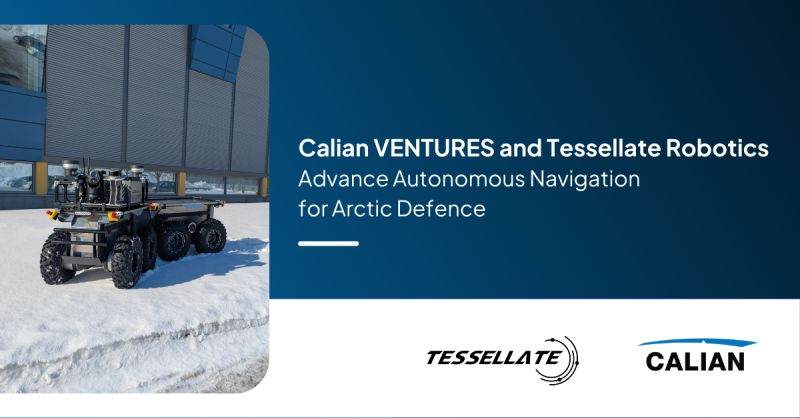
In Canada’s North—where satellite coverage thins, terrain shifts unpredictably, and extreme weather is the norm rather than the exception—navigation is not just a technical challenge. It is a strategic one.
That reality is driving a new collaboration between Calian Group Ltd. and Quebec-based Tessellate Robotics, aimed squarely at advancing autonomous navigation systems capable of operating where GPS cannot be relied upon. Announced under Calian VENTURES, the partnership reflects a broader push within Canada’s Defence Industrial Strategy to build sovereign, resilient capabilities tailored to the demands of Arctic and contested environments.
At its core, the collaboration brings together complementary strengths. Calian contributes its expertise in precision GNSS antennas, positioning, navigation and timing (PNT) technologies, and robotic software. Tessellate brings advanced navigation and inspection systems specifically designed for rugged, GPS-denied conditions. The result is a hybrid autonomous capability engineered to function where traditional satellite-based navigation systems are degraded, unreliable, or entirely unavailable.
But this is more than a technical integration exercise—it is a race toward operational relevance.
From Lab to Arctic Deployment
The partnership is moving quickly from concept to field validation. Joint testing is already underway, with the first operational deployment scheduled for March as part of Operation Nanook—Canada’s flagship Arctic sovereignty exercise.
Few environments offer a more punishing testbed. Low satellite geometry, extreme cold, limited visibility, and complex terrain combine to stress even the most advanced navigation systems. For Calian and Tessellate, this is precisely the point: proving performance in the Arctic is the benchmark for global relevance.
The collaboration also includes joint validation efforts designed to accelerate Tessellate’s growth and speed to market, while reinforcing Canada’s domestic capability in autonomous systems. In doing so, it aligns closely with federal priorities to strengthen industrial capacity while delivering deployable technologies for defence and allied operations.
Assured Autonomy in a Contested World
As Canada advances NORAD modernization and expands its Arctic presence, assured positioning, navigation, and timing has become a foundational requirement.
Modern defence operations increasingly depend on autonomous systems—from aerial platforms to ground robotics—that must function in environments where adversaries may disrupt or deny satellite signals. In the Arctic, even without adversarial interference, environmental conditions alone can degrade performance.
The Calian–Tessellate solution is designed to address this reality head-on.
By combining GPS-denied navigation with resilient GNSS and PNT capabilities, the system enables reliable autonomous operation even when satellite signals are jammed, disrupted, or absent. The technology is also engineered for Arctic-ready performance, validated against the harsh, low-visibility, and winter conditions unique to Canada’s North.
Equally important is its integration into modern defence architectures. Designed to align with C5ISRT frameworks, the capability supports seamless interoperability within command, control, communications, and intelligence ecosystems—ensuring that autonomous systems are not operating in isolation, but as part of a connected operational picture.
Beyond defence, the technology carries dual-use potential across sectors such as energy, mining, and critical infrastructure—industries that face similar challenges in remote and GPS-limited environments.
Building Sovereign Capability Through Partnership
For both companies, the collaboration underscores the importance of partnership in accelerating innovation and delivering operational outcomes.
“Canada’s North presents some of the most demanding navigation challenges in the world and operating in Arctic conditions requires more than autonomy alone,” said Dominic Baril, CEO, Tessellate Robotics. “By working with the right partners, like Calian and leveraging VENTURES, we can combine deep technical expertise and complementary capabilities to rigorously test, validate and ultimately deliver cutting-edge autonomous navigation systems for terrestrial and aerial platforms—supporting Canada and NATO’s defence priorities and interoperability.”
The emphasis on interoperability is critical. As Canada deepens its commitments to NORAD and NATO, systems developed domestically must integrate seamlessly with allied capabilities—particularly in contested and multi-domain environments.
For Calian, the collaboration is also a reflection of its VENTURES model: identifying and scaling high-potential Canadian innovators to accelerate capability development.
As Chris Pogue, President, Defence & Space, Calian Group, noted, assured navigation in contested environments is no longer optional. “As Canada strengthens its Arctic presence and advances NORAD modernization, assured navigation in GPS-denied environments is becoming a strategic requirement,” he said. “Through Calian VENTURES, we are partnering with high-potential Canadian innovators like Tessellate to accelerate the development of sovereign, deployable capability. Together, we are delivering autonomous systems that operate reliably in the North today and evolve to meet tomorrow’s defence demands.”
A Strategic Testbed for the Future
The Arctic is no longer a peripheral theatre—it is a proving ground for the future of defence technology.
As geopolitical competition intensifies and environmental conditions continue to challenge conventional systems, the ability to operate autonomously in denied or degraded environments is becoming a defining capability. For Canada, this is as much about sovereignty as it is about technological leadership.
Through their collaboration, Calian and Tessellate are not only addressing a critical operational gap—they are helping to establish a foundation for next-generation autonomous systems that can extend reach, enhance situational awareness, and operate with confidence in the most unforgiving environments on Earth.