
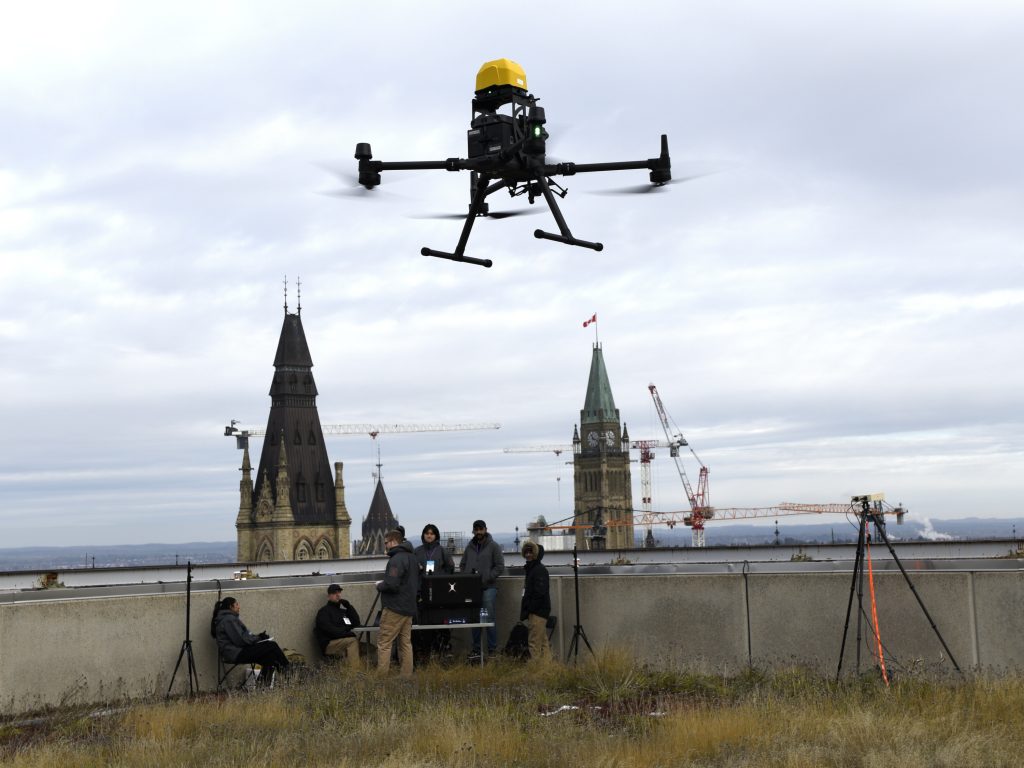
As drones become cheaper, smarter, and more accessible, Canada’s security landscape is shifting fast. The Department of National Defence (DND) responded to that reality in late November with a major milestone: the successful completion of downtown Ottawa drone-detection trials designed to test how emerging counter-uncrewed aircraft system (CUAS) technologies perform in the dense, unpredictable pulse of a busy capital city.
From November 24 to 28, Parliament Hill and its surrounding streets became a controlled testbed for one of the most complex CUAS demonstrations ever conducted in an urban Canadian environment. It was a setting chosen deliberately. Urban terrain poses unique detection challenges—radio interference, vertical towers, unpredictable traffic patterns, and large crowds. For defence scientists and operators working to safeguard critical government precincts, it is arguably the toughest environment in which to evaluate CUAS performance.
“Canada’s defence and security depend on staying ahead in a rapidly changing world. Innovation is the engine that drives progress and resilience. Canada’s future depends on investing in ideas, nurturing talent, and transforming knowledge into practical solutions for complex challenges. Now more than ever, we must invest in defence by advancing cutting-edge technologies, strengthening our domestic industrial base, and giving the Canadian Armed Forces the tools they need to protect Canadians,” stated the Honourable David J. McGuinty, Minister of National Defence.
A Collaborative Test of Innovation and Readiness
The trials were conducted under the banner of DND’s Innovation for Defence Excellence and Security (IDEaS) program, which continues to position Canada as a leader in rapid defence innovation. Over the course of the week, the event brought together a diverse coalition: innovators and defence technology developers, Canadian Armed Forces personnel, defence scientists, law-enforcement agencies, and municipal partners.
The Royal Canadian Mounted Police, the City of Ottawa, the Ottawa Police Service, Transport Canada, and other defence and security partners played central roles in coordinating the event. Their involvement underscored how counter-drone challenges increasingly cross departmental, jurisdictional, and technological boundaries.
With CUAS technology advancing rapidly—and potential threats evolving just as quickly—these partnerships are becoming essential. The trials offered a scientific and controlled environment where technologies could be evaluated safely and rigorously while mirroring the real-world complexities Canada faces in safeguarding critical infrastructure.
Meeting the Reality of an Evolving Threat
The urgency behind this work is clear. The rapid proliferation of drone systems—driven by falling costs, expanding capabilities, and commercial accessibility—has reshaped the global threat landscape. Small, inexpensive drones can now provide surveillance, disrupt operations, or deliver payloads with precision. For nations like Canada, this rise in uncrewed aerial activity demands a modernized and adaptable suite of defensive tools.
The IDEaS CUAS sandbox was created as a direct response to this growing challenge. By allowing innovators to test leading-edge solutions in realistic scenarios, the program aims to accelerate the development, refinement, and operational readiness of counter-drone technologies. It is one of many IDEaS initiatives designed to strengthen Canada’s defence innovation ecosystem and evaluate technologies that could eventually support the Canadian Armed Forces and its security partners.
Investing in Defence Innovation to Protect Canada’s Future
The trials also align with Canada’s broader strategic emphasis on building a more resilient and technologically advanced military. As global instability increases and digital disruption becomes a defining feature of modern conflict, maintaining a robust defence R&D capability is no longer optional—it is a foundation of national sovereignty and international credibility.
Through programs like IDEaS, the Government of Canada continues to invest in research, experimentation, and rapid innovation to reinforce military preparedness. These efforts support everything from protecting Canadian airspace to strengthening North American defence cooperation to contributing alongside allies around the world.
The urban CUAS sandbox event in Ottawa marks another step toward that goal—one that reflects both the scale of the drone-related challenges ahead and Canada’s determination to meet them with agility, science, and collaboration.