
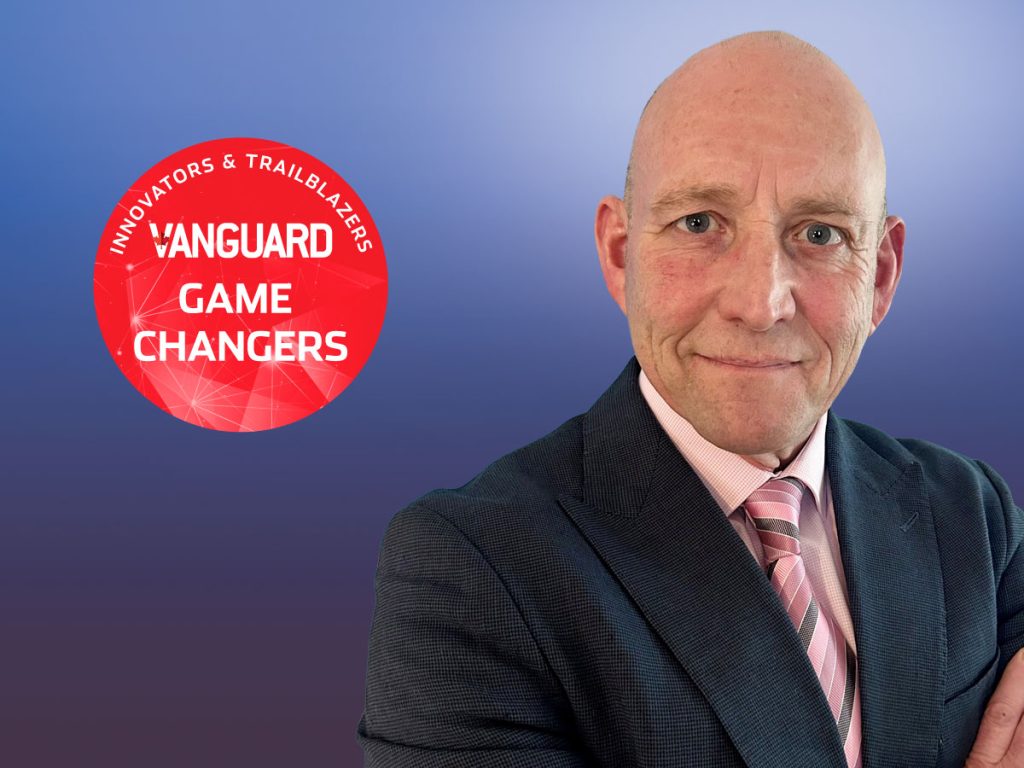
Steve Farley is Head of the Sonar Division and Project Management at Nautel Limited, where he leads the company’s sonar growth strategy and oversees project management across broadcast, navigation, and defence portfolios. With more than 40 years in the defence and security industry and 13 years at Nautel, Steve brings deep operational and technical experience to advancing high-power RF and sonar technologies.
He began his career with 26 years in the Royal Navy’s Fleet Air Arm, maintaining avionics systems on Sea King and EH101 (Merlin) helicopters, before transitioning into project management in the nuclear sector supporting the Astute-class submarine program. Since joining Nautel in 2012, Steve has helped expand the company’s project management capabilities and has played a key role in Nautel’s entry into sonar, including supporting delivery of hull-mounted sonar wet-end components for the Royal Canadian Navy’s Halifax-class Underwater Warfare Suite Upgrade program.
1. How did you start out in this industry and how has it brought you to where you are today?
My path into the defence industry has been a full-circle journey. I began with 26 years of service in the Royal Navy’s Fleet Air Arm, where I maintained avionics systems on Sea King and EH101 (Merlin) helicopters. That experience provided deep exposure to radio and sonar technologies, which laid the foundation for my future career.
I transitioned into project management, starting in the nuclear sector with Centronic Limited, where I contributed to the Astute-class submarine program. in 2012, I relocated to Canada and was fortunate to join Nautel Limited as a Project Manager for what was then the world’s largest digital radio initiative—designing, building, installing, and commissioning 27 high-power installations for All India Radio. I’ve been with Nautel ever since, steadily growing our Project Management Office.
As part of Nautel’s diversification strategy, we ventured into sonar technology—developing a sonar amplifier, acquiring C-Tech, and ultimately securing the contract to supply the Royal Canadian Navy with the wet-end components of the hull-mounted sonar systems for the Halifax class Underwater Warfare Suite Upgrade (UWSU) Program. It’s been a rewarding journey.
2. What is your role at your organization today?
I currently serve as Head of the Sonar Division and Project Management at Nautel. In this dual role, I oversee project management across our core business areas—broadcast, navigation, and sonar—ensuring delivery excellence across the portfolio.
More importantly, I lead our sonar division’s growth strategy, driving the development and market expansion of our sonar product line, which includes hull-mounted systems, low-frequency active (LFA) amplifiers, and transducers. My focus is on positioning Nautel as a premier supplier of sonar technologies by leveraging our deep expertise in high-power RF amplification—a capability that has defined our success in the commercial broadcast sector.
We’re now channeling that same spirit of innovation into the defence sonar space, building a reputation for reliability, performance, and forward-thinking design. My mission is to ensure that system integrators and defence stakeholders recognize Nautel as a trusted partner and a leader in anti-submarine warfare solutions.
3. What was your most challenging moment?
Nautel had always been an engineer-led company, so introducing formal project management practices—work breakdown structures, schedules, and asking engineers to estimate timelines—was a cultural shift. The key was communication. Once I combined clear planning with a bit of humour and the team saw those plans working, collaboration flourished. The All India Radio project was a huge success, leading to an additional order for six more systems.
Other challenges included our entry into the defense sector, where timelines are long and initial setbacks can feel discouraging. When early design issues arose, perseverance and teamwork carried us through. Today, we’re proud to have delivered a product for the Royal Canadian Navy that represents a step change in their ASW capability.
4. What was your A-HA moment or epiphany that you think will resonate most with our reader, tell us that story.
When I first left the Royal Navy and got my first PM job, I thought “right, er, what do I do now? I’m going to get found out. All these people know so much more about the commercial world than me!”. But after about a week or so, I realised, other than a bit of domain knowledge, rather than my fellow workers having the edge on me, I had the edge on them.
Armed services veterans I feel have a slightly different frame of reference to non-veterans and see problems that occur for what they are, something for which we must find a solution. We think team first and look to improve our team because, in the world we have lived, if one team member is below par, it could mean your life at risk.
5. What is the one thing that has you most fired up today?
I’m passionate about replicating Nautel’s reputation for reliability and trusted solutions in the commercial RF market within the sonar domain. Innovation has always been at the heart of Nautel’s story—we were the first to introduce solid-state design to navigation beacons and AM transmitters, pioneered touchscreens on high-power transmitters, delivered the world’s largest digital radio installation, built Europe’s most powerful radio transmitter, and even brought Digital Radio into the cloud. That track record speaks for itself.
Now, I have the privilege of leading an exceptional sonar design team—brilliant minds who are highly motivated to achieve great things. My goal is to harness that talent and energy to position Nautel, and Canada, at the forefront of anti-submarine warfare technology and sonar product innovation. The opportunity to push boundaries and redefine what’s possible in this space is what truly excites me.
6. What is the best advice you received?
The best advice I’ve ever embraced actually comes from a Sherlock Holmes story. In one scene, Dr. Watson is fretting about bad weather and concerned it will delay their train, while Holmes remains completely calm. When Watson asks why, Holmes explains that he only worries about things he can control—he reserves his energy for actions that make a difference. That principle has guided me throughout my career. In project management, countless things can go wrong, but focusing on what you can influence and mitigating those risks is key. It not only improves outcomes but also saves you from a lot of unnecessary sleepless nights.
7. What is a habit that contributes to your success?
One of the most valuable project management habits I’ve carried into the commercial world is the ability to take a complex problem and break it down into smaller, manageable pieces. It sounds simple, but too often we encounter challenges that feel overwhelming because of their size. Taking a step back and asking, “What’s the first thing I need to do?”—then the next, and so on—helps cut through that initial fog of uncertainty. Bit by bit, you chip away at the smaller pieces until the big problem no longer feels insurmountable.
8. What is your parting piece of advice?
I believe we are in a once in a generation period, where there is an opportunity to put Canadian technology and defence technology companies firmly in the spotlight. Let us all look within the country at all the amazing companies here and back them.
Questions regarding the ORGANIZATION
How is your organization changing the game within your industry sector?
Nautel has leveraged its decades of RF and high-power amplifier expertise to develop next-generation LFA sonar transmitters. These systems deliver higher reliability, efficiency, and scalability compared to traditional designs. By applying solid-state technology—similar to what revolutionized broadcasting—Nautel is reducing maintenance needs and improving operational uptime for naval platforms.
Nautel brings commercial engineering discipline and cost-efficiency into defense sonar projects, enabling faster development cycles and more affordable solutions without compromising performance. This approach helps navies and defense contractors meet tight budgets while still adopting cutting-edge technology.
Nautel challenges initial specifications and works closely with customers to define what they truly need, rather than just delivering what’s asked for. By integrating our expertise from RF, power electronics, and sonar domains, Nautel creates tailored solutions that outperform legacy systems.
2. What are some of the biggest impediments to innovation in your industry sector?
There are numerous opportunities to enhance innovation in the defence sector—
Workforce and Skills – Canada, and defense industries need to encourage the graduation and training of more acoustics, signal processing, and underwater systems. engineers
Streamlined Procurement – Faster procurement cycles and earlier engagement with industry will support rapid iteration and adoption of emerging technologies
Situation Appropriate Regulatory and Compliance – In some cases, easing strict military standards (e.g., MIL-SPEC) and certification requirements will foster experimentation, quick pivots and innovation.
3. How has innovation become engrained in your organization’s culture and how is it being optimized?
Innovation has always been at the heart of Nautel’s DNA—a principle instilled by our founder, Dennis Colville, over 55 years ago when he designed the first solid-state navigation beacon, despite industry skepticism. Our approach starts with understanding what the customer truly needs, challenging initial requirements, and leveraging expertise across all areas of the company to create innovative solutions.
4. What technologies, business models, and trends will drive the biggest changes in your industry over the next two years?
Over the next two years, I believe the defence sonar industry will be shaped by three key forces:
Technology – We’re seeing rapid advancements in digital signal processing, AI-driven classification, and low-latency data fusion. These are enabling sonar systems to become smarter, more adaptive, and capable of operating effectively in increasingly complex acoustic environments. Miniaturization, power efficiency and composite transducer materials are also critical, especially for unmanned platforms and distributed sensor networks and this is where we see Nautel focussing a lot of our efforts. How can we get the most power out for the least power in. Additionally, the integration of active and passive sonar with other sensor modalities—such as radar and EO/IR—will enhance multi-domain situational awareness.
Business Models – Defence procurement is shifting toward more agile, modular, and upgradeable systems. Open architecture and software-defined sonar platforms are gaining traction, allowing navies to extend system lifecycles and integrate third-party innovations more easily.
Industry Trends – Geopolitical tensions and the rise of peer adversaries are driving renewed investment in anti-submarine warfare and underwater surveillance. This is accelerating demand for scalable sonar solutions—from hull-mounted systems to deployable arrays and autonomous underwater vehicles. Sustainability and lifecycle cost are also becoming central to procurement decisions, pushing OEMs to innovate not just in performance, but in maintainability and long-term support.
At Nautel, we’re actively responding to these shifts—leveraging our expertise in high-power RF and sonar amplification, expanding our sonar portfolio, and building strategic partnerships to deliver next-generation capabilities to our customers.