
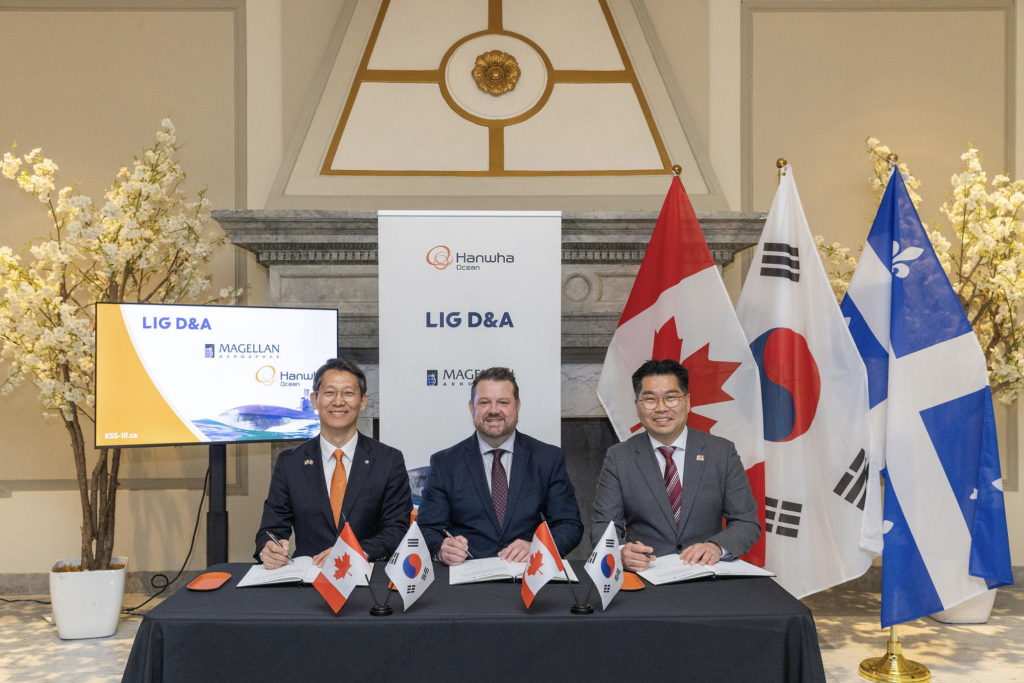
Canada’s future submarine capability is increasingly being defined not just by what it acquires—but by what it builds, integrates, and sustains at home.
A newly signed Memorandum of Understanding between LIG Defense & Aerospace (D&A), Magellan Aerospace Corporation, and Hanwha Ocean marks a significant step in that direction. Anchored in the Canadian Patrol Submarine Project (CPSP), the partnership is focused on establishing in-country capacity for critical underwater weapon systems and their full lifecycle support—an evolution that signals a broader shift in how Canada approaches defence capability.
At the core of the collaboration is the pairing of LIG D&A’s advanced undersea weapons expertise with Magellan’s established precision manufacturing footprint in Canada. LIG has been instrumental in shaping South Korea’s indigenous submarine capabilities, from the development of the Baeksang-eo heavy weight torpedo to more advanced systems such as the Tiger Shark, which integrates fibre-optic guidance and wake-homing technologies and is deployed aboard KSS-III submarines. Beyond torpedoes, its portfolio spans mobile mines, submarine-launched cruise missiles, and torpedo countermeasure systems—capabilities that form the backbone of modern undersea warfare.
The intent now is to bring elements of that capability into Canada.
“LIG brings a level of proven capability in underwater weapon systems that is not widely available in the global market,” said Haydn Martin, Vice President, Business Development, Marketing and Contracts at Magellan. “Partnering on that foundation creates a real opportunity to establish advanced manufacturing and sustainment capacity in Canada – moving critical capabilities closer to home and strengthening long-term operational readiness.”
The partnership is exploring a phased industrial approach. Initial efforts would focus on assembling and producing key submarine weapon systems and unmanned platforms within Canada. From there, the roadmap expands toward deeper local sourcing, component manufacturing, and the establishment of maintenance, repair, and overhaul (MRO) capabilities—critical to sustaining a future submarine fleet over decades of operation.
Over time, the collaboration could extend even further, positioning Canada as an export hub for assembled systems to allied markets.
Parallel discussions are also underway on propulsion systems for 70mm guided rockets, with potential expansion into broader solid rocket motor applications, including 130mm and 140mm systems. These efforts point to a deliberate strategy: diversify Canada’s defence supply chain while building depth in areas that have traditionally remained externally sourced.
The agreement builds on earlier collaboration between Hanwha Ocean and LIG D&A in underwater and sonar-related systems, forming part of a more integrated approach to undersea warfare capability development in Canada. This includes ongoing discussions around the localization of torpedo countermeasure systems and related technologies—early indicators of a longer-term shift toward domestic production and sustainment.
For Canada, the implications extend beyond a single program. By bringing together production, integration, and in-service support within its own industrial base, the country is positioning itself to reduce dependency, strengthen supply chain resilience, and ensure sustained operational readiness for complex naval platforms.
With Magellan’s established role in advanced manufacturing and defence production, the pathway is clear: move from final assembly toward deeper, component-level participation—unlocking broader opportunities for Canadian industry while reinforcing the sustainment backbone required for a modern submarine fleet.
In the context of CPSP, this is more than partnership building. It is capability building—designed to endure.