

How a proven, made‑in‑Canada innovative service restored critical naval capability, reduced cost to taxpayers, and offers a model for future maritime readiness.
Introduction: Capability, Delivered When It Mattered
Naval power is not measured solely by the number of warships in a fleet. It is measured by how long those ships can remain at sea, how far they can operate from home ports, and how reliably they can be sustained in demanding environments. Endurance, readiness, and resilience are the quiet determinants of maritime effectiveness, often invisible to the public, but decisive in operations.
For the Royal Canadian Navy (RCN), the introduction of CSS Asterix marked the restoration of a critical capability at a pivotal moment. Delivered in 2018, through a Contractor Owned, Contractor Operated (COCO) service delivery model, Asterix demonstrated that Canada could rapidly regain at‑sea support capacity by combining private capital, commercial marine expertise, and naval professionalism, without sacrificing operational credibility or control.
Nearly a decade later, Asterix stands not as an interim solution, but as a proven force multiplier. As the vessel’s lease period nears completion, Canada faces a strategic decision: whether to retain this capability through a service extension or acquisition and transition to a Government Owned, Contractor Operated (GOCO) model, or risk losing a uniquely effective Canadian asset that has operated flawlessly, already paid dividends in operational flexibility, fiscal predictability, and alliance credibility.

A Capability Gap—and an Unconventional Solution
When Asterix was proposed, Canada faced a well‑understood challenge: the loss of organic at‑sea replenishment capability and constrained naval operations. Without reliable support vessels, even the most capable combatants are tethered to shore logistics and allied availability.
Rather than waiting for a traditional, government‑funded capital procurement cycle, Davie Shipbuilding advanced a different proposition. Using private equity, Davie converted a relatively new, well-constructed containership, the Asterix, into a combat support ship that met all the legacy capabilities of the original Protecteur Class AORs, plus certified to Lloyd’s Register and Transport Canada standards. The Asterix was proposed to Canada as a turn-key solution, fully crewed by experienced Canadian Merchant Mariners and managed by experienced ship managers employed by Federal Fleet Services (FFS). The Asterix crew are responsible for ship navigation, watchkeeping and maintenance while the RCN / theCanadian Armed Forces (CAF) provides the Mission Specialists. The sailors onboard work together in a fully integrated manner, adopting the motto of: One Ship, One Team, One Mission.
This approach fundamentally reduced the risk and service delivery cost equation:
- Private financing reduced upfront fiscal exposure for the government
- Fixed‑price and firm service delivery date ensured cost certainty
- Performance‑based contract aligned service delivery incentives with operational outcomes
The result was a ship delivered on time, on budget and meeting all performance requirements, restoring a capability that would otherwise have taken many additional years to materialize.
“Capability delayed is capability denied.”
From Concept to Operational Reality
What distinguishes Asterix is not the novelty of its business model, but the credibility of its operational record.
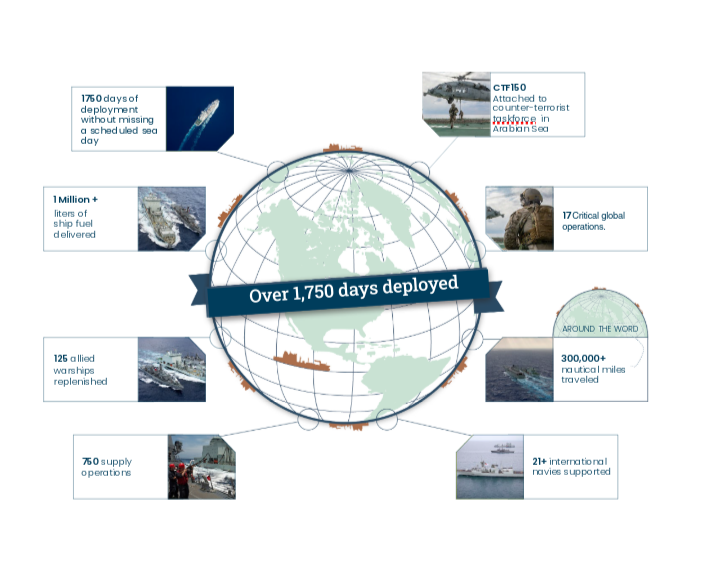
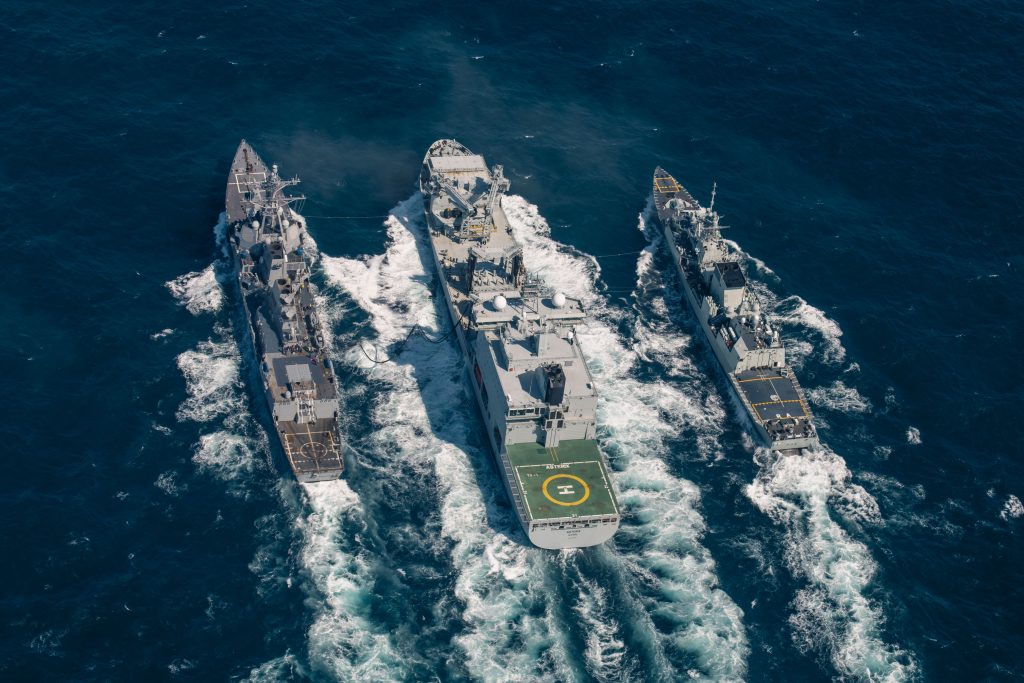
Since entering service, CSS Asterix has delivered sustained operational output at a scale that underscores its role as a force multiplier for the Royal Canadian Navy. The vessel has logged nearly 300,000 nautical miles, conducted 538 replenishments at sea, and transferred more than 107,000 cubic metres of naval fuel and nearly 2,800 cubic metres of aviation fuel to Canadian and allied warships—equating to over 106 million liters of naval fuel and more than 265,00 liters of aviation fuel delivered at sea. These figures reflect not episodic support, but continuous, high‑tempo operations that enable task groups to remain deployed longer, operate farther from shore, and maintain operational independence across multiple theatres.
By restoring at‑sea replenishment, Asterix has:
- Extended the reach and tempo of RCN task groups
- Enabled warships to remain on station longer
- Reduced Canada’s dependence on allied availability for routine sustainment
- Increased confidence in deployment planning and training cycles
- Provided a dependable and valuable defence contribution to our NATO partners
Crucially, this model does not replace traditional naval capability. It amplifies it—allowing combatants to focus on combat readiness while support functions are delivered seamlessly alongside them.

Partnership at Sea: A Proven Civilian–Naval Model
The integrated civilian–naval crew aboard Asterix reflects a long‑standing maritime tradition rather than a departure from it.
During the Second World War, merchant mariners were indispensable enablers of naval power, sustaining fleets in contested environments and under constant threat. That legacy continues aboard Asterix, where civilian mariners and naval personnel operate together—each bringing distinct expertise, united by a shared mission.
This partnership is best understood as complementary capability:
- Civilian mariners bring deep commercial marine experience in ship handling, engineering, and maintenance
- Naval personnel provide operational command, military integration, and task‑group coherence
Rather than competing with naval auxiliaries, Asterix reinforces the overall support ecosystem, filling gaps when needed and integrating seamlessly into multinational task groups.

Interoperability and Alliance Value
Modern naval operations are rarely conducted alone. Interoperability—with allies, with commercial partners, and across different classes of vessels—is a strategic necessity.
Asterix does not operate in isolation. It works alongside:
- Allied support vessels
- Traditional naval auxiliaries
- Future fleet assets as they come online
This scalable, adaptable posture is a defining strength of the Asterix service delivery model, whether it be through a COCO or a GOCO. It avoids locking government into a single, rigid solution while preserving the ability to surge or adapt capability as operational demands evolve.
For Canada’s NATO partners, Asterix represents something equally important: credibility. A navy that can sustain itself at sea is a navy that can contribute meaningfully to coalition operations.
Fiscal Discipline and Public Value
Beyond operational outcomes, Asterix tells a compelling fiscal story.
Through fixed‑price delivery, private financing, and performance‑based service, the program reduced both schedule risk and cost uncertainty, two persistent challenges in large defence procurements. In each year of operation, the ASTERIX has returned millions of dollars in budget back to the RCN, a truly unique accomplishment in defence contracting.
For nearly a decade, the vessel has operated without a single day of unplanned downtime, leveraging the strength of a highly trained crew, strategic alignment with Tier 1 subcontractors and Canada’s commercial marine sector. This record matters, not just as a point of pride, but as evidence that commercial best practices can coexist with military requirements when incentives are aligned correctly.
From a taxpayer perspective, the COCO and GOCO models:
- Shift construction, maintenance and operational availability risk away from the government.
- Delivered new capability and sustained existing capability sooner and more efficiently than traditional acquisition paths.
- Provide predictable costs tied to performance.
- Utilize capable and qualified Canadians as force multipliers to fulfill military needs.
A Strategic Decision Point: Lease or Legacy?
As the lease period for Asterix nears completion, Canada faces a choice that is as strategic as it is practical.
Allowing the capability to lapse would mean relinquishing a proven, Canadian‑built, Canadian‑operated asset, one that has already demonstrated its value in real operations.
Extending the current service model (COCO) or Purchasing Asterix and transitioning to a Government Owned, Contractor Operated (GOCO) model would:
- Retain the benefits of commercial marine operations as a force multiplier
- Ensure this strategic asset and capability remain available to the RCN and NATO allies
- Preserve combat support ship domestic expertise and capacity within Canada’s marine sector by maintaining the 120 direct and 250 indirect jobs related to the service
This is not about choosing between public and private. It is about recognizing that smart integration of both delivers better outcomes than either could alone.
Conclusion: A Model Worth Keeping—and Repeating
CSS Asterix proves that civilian–naval cooperation is not experimental. It is operationally credible, historically grounded, and strategically smart.
It shows how Canada can harness private capital, domestic innovation, and merchant marine expertise to deliver real capability—quickly, reliably, and at scale.
The question now is not whether the model works. The record answers that decisively.
The question is whether Canada is prepared to recognize success, secure it for the future, and apply its lessons to the next generation of maritime capability at a time when capacity is a capability of its own.