
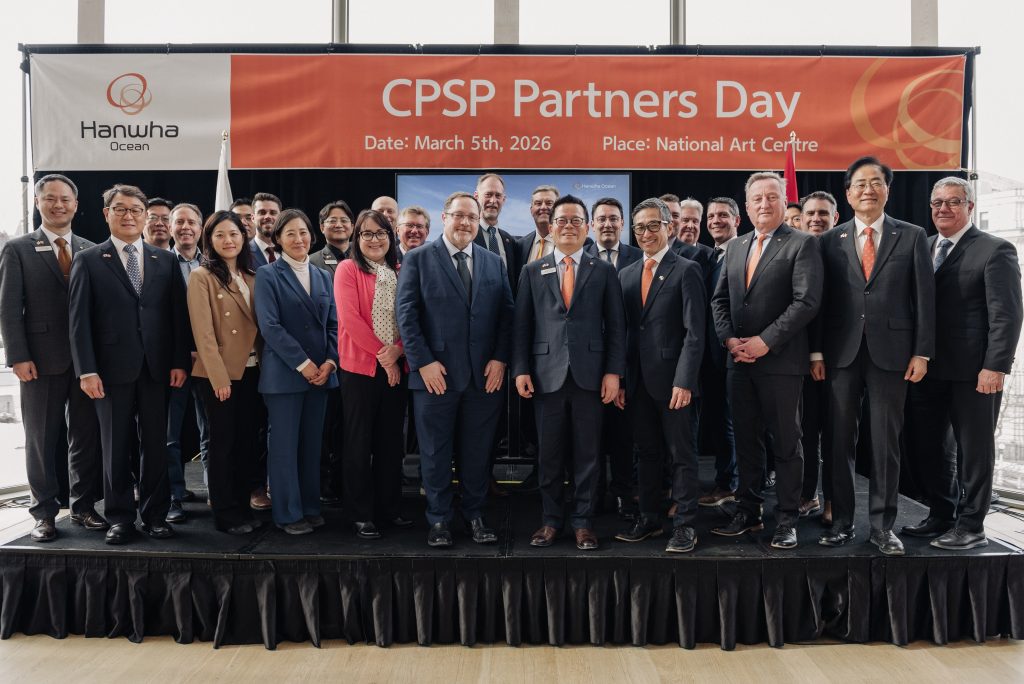
In Ottawa this week, a gathering of industry leaders, researchers, and government stakeholders highlighted a growing reality: Canada’s submarine future is not only about ships beneath the sea—it is about building an ecosystem above it.
At the National Arts Centre, international naval shipbuilder Hanwha Ocean convened its Canadian Patrol Submarine Project (CPSP) Partners’ Day, announcing a series of new industrial and academic partnerships designed to bring Canadian companies and universities into a global submarine supply chain.
The announcement included five Teaming Agreements with Canadian industry partners and three Memoranda of Understanding with leading Canadian universities, linking Ontario and Atlantic Canada directly to advanced naval programs and international defence technology networks.
The agreements reflect Hanwha Ocean’s broader commitment to building long-term industrial partnerships in Canada while strengthening domestic manufacturing capacity, research innovation, and workforce development aligned with the country’s Industrial and Technological Benefits (ITB) policy and “Buy Canadian” objectives.
Building Canada’s Submarine Industrial Ecosystem
The newly announced Teaming Agreements connect Canadian firms with Hanwha Ocean and international defence partners across several critical submarine capability areas—from undersea warfare systems to power management, navigation technologies, and integrated platform controls.
Each agreement is structured as a tri-party collaboration, pairing a Canadian company with Hanwha Ocean and an international technology partner.
Among the partnerships announced:
- GeoSpectrum Technologies Inc. and Ultra Maritime, both based in Dartmouth, Nova Scotia, will work alongside Hanwha Ocean and Korea’s LIG Nex1 on underwater acoustic sonar and undersea warfare systems.
- Aspin Kemp & Associates (AKA Energy Systems) in Prince Edward Island and J-Squared Technologies Inc. in Kanata, Ontario will collaborate with Hanwha Ocean and Korea’s KTE on power distribution systems, electrical controls, embedded computing, and integrated platform management systems.
- Safran Trusted 4D Canada, based in Montreal, will partner with Hanwha Ocean and Safran Electronics & Defense in France, combining Canadian systems integration expertise with advanced optronics, inertial navigation, radar, and defence electronics technologies supporting submarine and naval programs.
Taken together, the partnerships create new pathways for Canadian companies to contribute directly to global submarine production and sustainment networks.
“CPSP represents an opportunity to build long-term industrial partnerships that deliver real value for Canada. Through these agreements, we are strengthening domestic capabilities, supporting regional economic development, and helping build a future-ready Canadian defence workforce. By combining Canada’s advanced technologies with Korea’s proven submarine manufacturing expertise, we believe we can deliver a solution aligned with Canada’s national interests,” said Glenn Copeland, CEO, Hanwha Defence Canada.
Atlantic Canada at the Centre of Undersea Innovation
For Atlantic Canada, the agreements underscore the region’s growing importance in underwater acoustic research and maritime defence technology.
Dartmouth-based GeoSpectrum Technologies—a company long associated with advanced sonar systems—sees the collaboration as a natural extension of the region’s expertise in undersea technologies.
“These agreements demonstrate how Canadian undersea and marine technology companies can contribute meaningfully to a global submarine program. For Atlantic Canada, this represents an opportunity to further strengthen our expertise in underwater acoustics and position regional innovation at the centre of advanced naval capability,” stated Paul Yeatman, President, GeoSpectrum Technologies Inc.
The partnership with Ultra Maritime, a long-standing supplier to the Royal Canadian Navy’s Victoria-class submarines, further reinforces Canada’s undersea warfare expertise.
“Ultra Maritime is proud to bring advanced sovereign capabilities to the Canadian Patrol Submarine Project. With decades of proven success supporting the Royal Canadian Navy’s Victoria-class submarines, Ultra Maritime brings unmatched experience and expertise in undersea warfare, as well as an established Canadian industrial footprint,” conveyed Peter Currie, Vice President of Finance, Ultra Maritime.
Engineering the Systems Behind the Fleet
Beyond acoustic systems, the CPSP partnerships extend deep into the digital and electrical infrastructure required to power modern submarines.
Prince Edward Island’s Aspin Kemp & Associates (AKA Energy Systems) and Ottawa-area J-Squared Technologies will focus on energy distribution, platform controls, and embedded computing—core components that enable next-generation naval platforms.
“Through this collaboration with Hanwha Ocean, AKA Energy Systems is bringing Canadian power integration and control system expertise into an international naval program. It’s an opportunity to showcase the homegrown innovation and skill coming from Prince Edward Island. This agreement will create opportunities for high-value engineering work in Prince Edward Island while supporting the development of more efficient and resilient maritime platforms,” explained Jason Aspin, CEO AKA Energy Systems.
For J-Squared Technologies, the partnership builds on decades of expertise in mission-critical computing.
“J-Squared Technologies’ partnership with Hanwha Ocean is a testament to decades of leadership in high-performing embedded computing and mission-critical systems integration and the power of strategic collaboration. We’re proud of contributions to the Canadian Patrol Submarine Project that are helping to advance Canada’s naval defence-industrial base and technological future,” expressed Andrew Woollard, President, J-Squared Technologies Inc.
Meanwhile, Safran Trusted 4D Canada brings advanced navigation and sensor technologies into the partnership.
“Safran Trusted 4D Canada welcomes this collaboration with Hanwha Ocean as an important step in strengthening Canada’s contribution to advanced naval capabilities. Through this Teaming Agreement, we are leveraging our expertise in trusted navigation and mission-critical systems to support next-generation submarine programs while expanding Canada’s role in the global defence supply chain,” said Louis Girardin, CEO, Safran Electronics & Defence Canada.
Universities Powering the Next Generation
Industry partnerships were only part of the story emerging from Ottawa. Hanwha Ocean also signed three academic Memoranda of Understanding with:
- University of Toronto
- University of New Brunswick
- Dalhousie University
The agreements focus on collaborative research and workforce development in several advanced fields:
- AI-enabled naval and maritime systems
- Digital engineering and simulation technologies
- Underwater acoustic and stealth technologies
- Arctic-capable vessel technologies
- Intelligent and automated systems aimed at reducing crew requirements
For universities, the collaborations offer a direct pathway to connect academic research with real-world naval engineering programs.
“As a Canadian leader in marine research and education, the University of New Brunswick is proud to partner with Hanwha on this important collaboration. This agreement creates meaningful opportunities for applied research and hands-on student engagement in advanced marine and defence technologies. By aligning our academic expertise with global industry leadership, we will strengthen Canada’s maritime innovation ecosystem and long-term industrial capacity,” stated Dr. Paul J. Mazerolle, President and Vice Chancellor, University of New Brunswick.
The University of Toronto emphasized the potential to translate advanced research into practical maritime applications.
“Partnering with Hanwha Ocean allows us to connect leading-edge research in areas such as artificial intelligence and advanced systems engineering with real-world maritime applications. These collaborations strengthen Canada’s innovation ecosystem, elevate our sovereign capabilities and prepare our students to contribute to complex global engineering programs,” said Illan Kramer, Director of International Research Partnerships, University of Toronto.
At Dalhousie University, the partnership reflects the institution’s deep connections to Canada’s ocean science and maritime communities.
“Dalhousie University is proud to partner with Hanwha Ocean through this Memorandum of Understanding and to support the research and talent capacity at our university committed to advancing Canada’s leadership in ocean science, marine engineering, and Arctic research. As a university deeply connected to our province and region’s maritime and defence communities, we see this collaboration as an opportunity to open pathways for our researchers and students to make important contributions to an initiative with the potential to enhance Canadian sovereignty, while accelerating innovation in AI-enabled naval systems, autonomous technologies, and Arctic-capable vessel design,” expressed Dr. Graham Gagnon, Vice-President, Research and Innovation, Dalhousie University.
A Strategic Canada–Korea Partnership
The Ottawa event drew participants from across Canada’s defence ecosystem, including economic development agencies, industry leaders, academic institutions, military stakeholders, and representatives from the Embassy of the Republic of Korea in Canada.
Their presence underscored the broader geopolitical and economic significance of the collaboration.
As Canada evaluates future submarine options under the Canadian Patrol Submarine Project, industrial partnerships such as these highlight how international defence programs increasingly function as multi-decade industrial ecosystems, spanning manufacturing, research, workforce development, and innovation.
For Hanwha Ocean, the newly announced agreements represent only the beginning.
The company says it will continue expanding partnerships with Canadian industry and research institutions as it advances its CPSP proposal—positioning itself as a long-term industrial partner committed to strengthening Canada’s defence ecosystem, innovation capacity, and skilled workforce.