
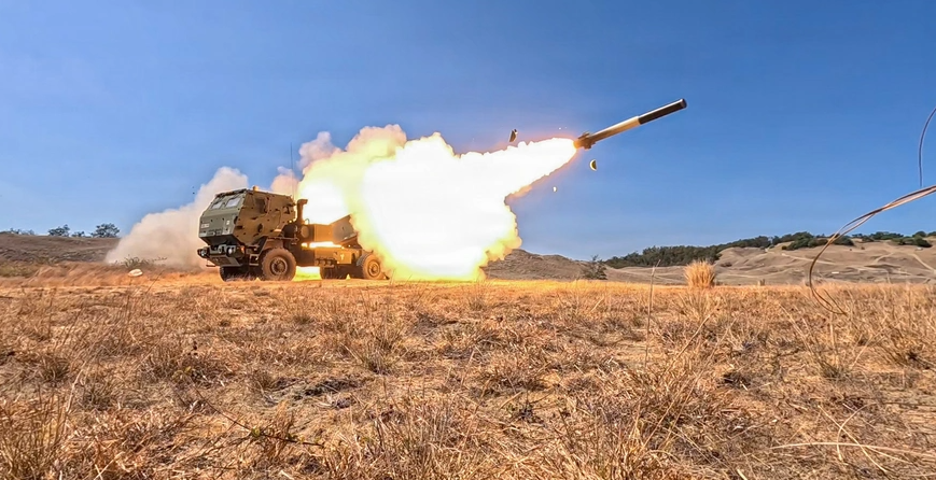
The $2.6 billion deal gives Canada a mobile land-based strike capability at ranges beyond 300 kilometres, with a future role in coastal and Arctic defence.
Canada has finalized a deal to acquire 26 High Mobility Artillery Rocket System (HIMARS) launchers from the United States, giving the Canadian Army a long-range precision strike capability it has never had before.
The agreement was signed in January 2026 under the U.S. Foreign Military Sales program. It includes a preliminary operational stock of munitions, spare parts, training and support services, with deliveries expected to begin in 2029.
The total acquisition cost for the Long Range Precision Strike (Land) project is estimated at $2.6 billion CAD, including project management, infrastructure, contracts and contingency.
A new reach
Canada has long planned to add greater range and precision to the Army’s land fires capability. HIMARS moves that effort into a concrete acquisition, giving the Canadian Army a mobile system built for long-range strike.
The practical effect is simple: the Army can engage targets from standoff distances, while operating more naturally alongside allies that have spent years integrating long-range fires into NATO planning, joint targeting, sensors, air power and command-and-control networks.
DND says HIMARS was selected after an evaluation process and was identified as the only solution that best met Canada’s operational and technical requirements. The department also made clear why the purchase is moving through the U.S. Foreign Military Sales program: there is no Canadian manufacturer for the launcher system or the associated long-range missile capability, and HIMARS is not commercially available.
More than artillery
The most interesting part of the announcement may be what comes next.
DND says the systems are designed to integrate future land-based anti-ship missile capabilities to support the defence of Canada’s coasts, including the Arctic. That points to a broader role for HIMARS beyond traditional land fires.
A mobile missile system that can move by air, deploy across Canada and eventually contribute to coastal defence gives Ottawa more options across a very large map. It does not replace ships, aircraft, sensors or northern infrastructure, but it does add another layer to Canada’s deterrence posture.
LGen Michael Wright, Commander Canadian Army, said the new launchers will be deployable across Canada, including the Arctic, and abroad using existing Royal Canadian Air Force aircraft.
The industrial angle
The HIMARS deal also shows how Canada’s new defence industrial approach works when there is no domestic system to buy.
Under the Industrial and Technological Benefits Policy, Lockheed Martin Missiles and Fire Control will be required to provide business activities and investments in Canada equal to the value of its activities related to the Foreign Military Sale. DND says those activities are expected to include integrating Canadian companies into global supply chains, investing in Canadian research and development, and supporting small and medium-sized businesses.
Long-term in-service support will be acquired separately. The launcher purchase is only the start: munitions, training, sustainment, targeting systems and future anti-ship missile integration will determine how much operational value Canada gets from the system.
For now, the significance is clear: Canada is adding a land-based strike capability with real range, allied relevance and a planned role in coastal and Arctic defence. As the Army modernizes for a more contested operating environment, HIMARS gives it a new reach and a more credible place in joint and coalition fires planning.