
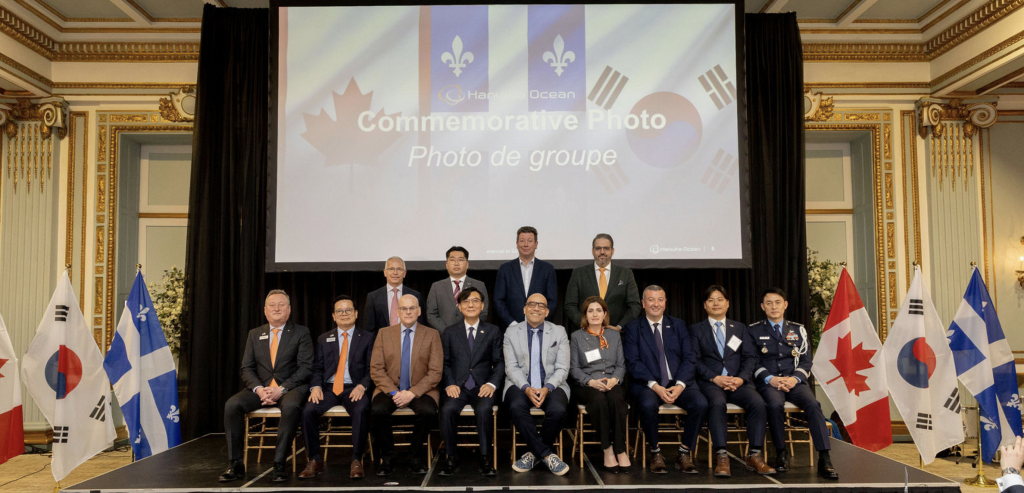
At Hanwha Ocean’s Canadian Patrol Submarine Project (CPSP) Partners Day, a series of agreements and partnerships outlined a growing industrial framework designed to support not only the acquisition of submarines, but their full lifecycle in Canada. The shift reflects a broader recognition that long-term operational sovereignty will depend on domestic capacity to produce, integrate, sustain, and upgrade these complex platforms.
Held at Le Windsor Ballroom in Montreal, the event brought together leaders from across government, industry, academia, and advanced manufacturing. With representatives from Québec, the Republic of Korea, Investissement Québec International, and the City of Montreal in attendance, the gathering underscored the scale of coordination required to deliver a sovereign submarine capability.
At the centre of the announcements was a network of Memoranda of Understanding (MOUs) and Teaming Agreements (TAs) spanning key pillars of submarine capability. These agreements collectively aim to localize advanced manufacturing, systems integration, digital engineering, and long-term in-service support within Canada—aligning with the priorities of the country’s Defence Industrial Strategy.
Several partnerships highlighted the importance of securing domestic production for mission-critical components. Collaboration with Velan focuses on sourcing high-spec submarine valve systems within Canada, while agreements involving Kolon Spaceworks, Spartec Composites, and Thordon Bearings point to the early formation of a Canadian supply chain for advanced materials, propulsion components, and composite structures.
Beyond component manufacturing, other agreements signal a move toward deeper system-level capability. A teaming arrangement with LIG Defense & Aerospace and AtkinsRéalis includes the development of acoustic testing facilities and supporting infrastructure—key enablers for submarine systems validation and long-term sustainment. This approach positions Canada to establish sovereign in-service support capacity from the outset.
Digital capability is also emerging as a defining element of the strategy. Through collaboration with Dassault Systèmes Canada, efforts are underway to build in-country expertise in submarine design, simulation, and product lifecycle management. This not only supports sustainment but enables continuous modernization—ensuring platforms remain relevant over decades of service.
Taken together, the Montreal announcements reveal more than a set of agreements. They represent the early architecture of a Canadian-based submarine industrial ecosystem—one that integrates advanced manufacturing, engineering, digital systems, and sustainment into a cohesive, long-term capability.
Building on earlier engagements across Ottawa, Calgary, and Toronto, this latest phase strengthens alignment between international partners and Canada’s industrial priorities, particularly within Québec’s aerospace and advanced manufacturing sectors.
As the CPSP evolves, the focus is becoming increasingly clear: the future of Canada’s submarine capability will be defined as much by what is built onshore as what operates beneath the surface.