
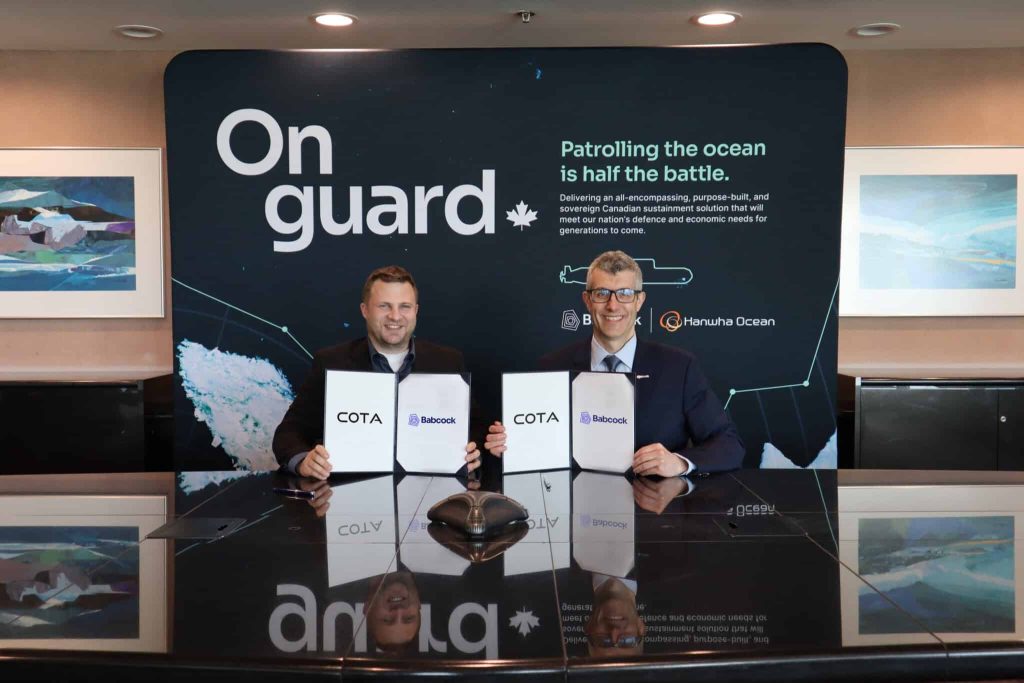
As Canada’s future submarine program moves closer to a preferred supplier decision, another piece of the industrial puzzle is beginning to take shape at home. Babcock Canada and COTA Aviation have signed a Memorandum of Understanding aimed at developing sovereign manufacturing solutions for the KSS-III Batch-II Weapons Handling and Launch Systems under the Canadian Patrol Submarine Project.
The agreement positions the two companies to support one of the most technically demanding elements of submarine capability: the systems responsible for safely handling, storing, and launching weapons aboard the platform.
For Babcock, the move builds on decades of experience in submarine sustainment and weapons handling integration. The company, which serves as the Prime Contractor for Canada’s Victoria In-Service Support Contract, has more than 40 years of global expertise in Weapons Handling and Launch Systems design and manufacturing. Its systems have been integrated across a broad range of naval platforms, including both Canada’s Victoria-class submarines and South Korea’s KSS-III fleet.
COTA brings a different but increasingly important capability to the table. The Canadian advanced manufacturing company has developed digitally enabled production systems and gained direct Royal Canadian Navy project experience as a prime contractor. Through the partnership, COTA is expected to help establish a domestic industrial capability capable of supporting complex naval manufacturing work from within Canada’s own supply chain.
The agreement reflects a broader shift taking place across Canada’s defence sector, where procurement conversations are increasingly tied to sovereign industrial capacity, domestic sustainment, and long-term economic participation. With Ottawa placing greater emphasis on “Build Canadian First” approaches, partnerships that combine international defence expertise with Canadian manufacturing capacity are becoming central to future capability discussions.
The MOU also builds on an existing relationship between the two firms. Earlier collaboration under an Industrial and Technological Benefits project helped support COTA’s transition into a digitally enabled manufacturer. In 2024, the companies continued working together on a contract to modernize obsolete galley components aboard Canada’s four Victoria-class submarines.
Under the new framework, COTA is expected to play a role in Babcock’s broader sustainment strategy for the Canadian Patrol Submarine Project — one focused not only on operational support, but also on skills transfer, industrial participation, and domestic job creation.
“This MOU represents an important step in our shared vision to strengthen Canada’s sovereign naval sustainment capability. As Babcock plans to deliver an all-encompassing and purpose-built submarine sustainment solution, this partnership enables us to develop a domestic manufacturing capability, while leveraging a Canadian subject matter expert and building on the Government of Canada’s localization strategies,” explained Tony March, CEO, Babcock Canada.
“This MOU marks a significant milestone in COTA’s growth as a Canadian defence manufacturer. It recognizes the capability our team has built and creates a pathway to apply that capability to future submarine systems. We are proud to work with Babcock to help bring more high-value naval manufacturing work, skilled jobs, and technical knowledge into Canada’s industrial base,” expressed Kyle Kusznieryk, CEO, COTA Aviation.
As the Canadian Patrol Submarine Project advances, industrial partnerships like this one are becoming increasingly important indicators of how competitors intend to build long-term capability inside Canada — not just deliver submarines, but establish the industrial ecosystem required to sustain them for decades.