
Canada is making historic investments to modernize the CAF. Meeting the NATO benchmark of investing two per cent of GDP in defence reflects the most significant reset of defence spending in Canada since the end of the Cold War. New aircraft, ships, and land systems will reshape the capabilities of the Canadian Armed Forces and strengthen Canada’s contribution to allied security. But platforms alone do not deliver operational readiness. Well-trained people are the backbone of a resilient and operationally effective military. As military technology becomes more advanced, interconnected, and data‑driven, the challenge of preparing people to use that technology has never been more critical.
Today’s operational environment is fundamentally different from the one in which many legacy training systems were conceived. Modern military platforms are no longer standalone tools. They must function in a highly networked joint battlespace where information flows across domains, actions in one environment can have immediate consequences in another, and decisions must be made quickly under significant time pressure and conditions of ambiguity. Training systems optimized for learning procedures on individual platforms struggle to reflect this reality.
Canada already operates some of the most sophisticated platforms in the world, from advanced maritime patrol aircraft to modern naval vessels and helicopters. While these systems are increasingly automated and, in some ways, easier to physically operate, they are more complex than ever to employ effectively. Success now depends less on mastering rote procedures and more on sound judgement, situational awareness, crew coordination, and decision-making under pressure. To ensure the readiness and resilience of an effective defence force, training must develop these collective human skills.
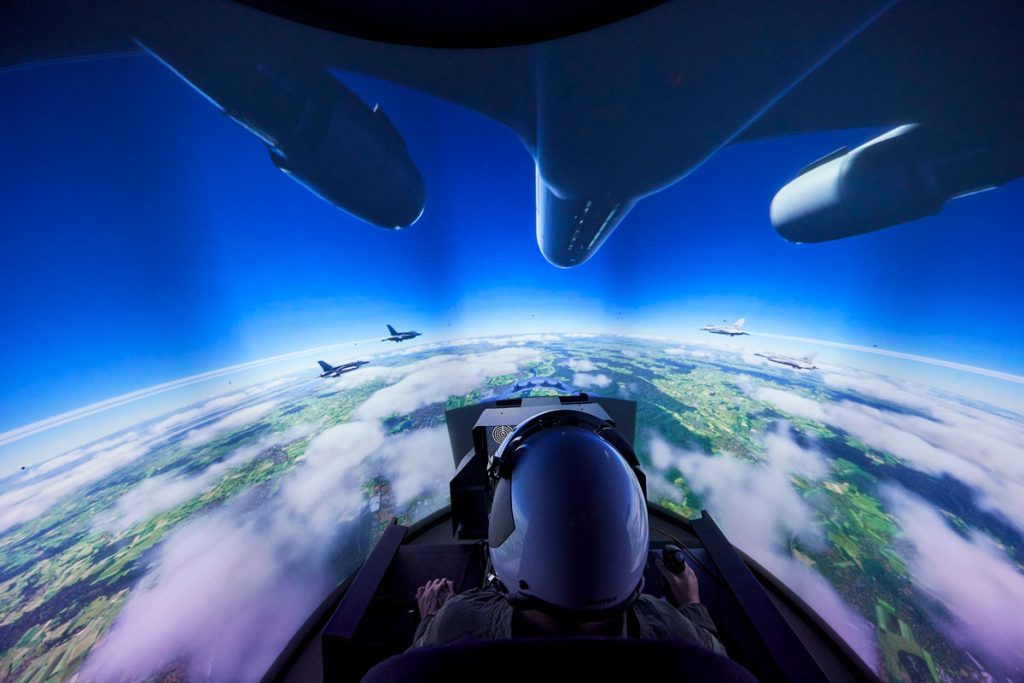
This is where integrated training and simulation ecosystems become important. Rather than viewing training as a secondary, platform‑centric add-on, modern approaches recognize training as a core operational capability driver in its own right. Building on sound foundations of learning science and human cognitive understanding, modern training ecosystems span multiple domains, including air, land, naval, cyber, and space, and are designed to prepare individuals, crews, and units to operate collectively in realistic, mission-relevant scenarios. The goal is not simply to train individuals to operate equipment (although building procedural mastery is still critical), but to enable teams to perform together in realistic, joint, and collective scenarios that mirror how modern missions are actually conducted.
Several forces are driving this shift. First is the rapid transformation of the joint battlespace, and the emergence of interconnected mission environments that link sensors, platforms, and decision‑makers at every level. Second is the rise of artificial intelligence, advanced analytics, and adaptive learning technologies that make it possible to personalise training while maintaining consistency and standards. Third is the evolution and convergence of technical standards that enable training systems to share data, integrate seamlessly, and generate valuable insights about a student’s performance and readiness.
Together, these developments point toward a future where training is not limited or confined to isolated simulators. Instead, training becomes a persistent activity, delivered in and enabled by a data‑rich environment that supports not only instruction, but mission rehearsal, readiness assessment, and continuous improvement. Within this ecosystem, training becomes a strategic enabler of operational effectiveness, and an essential tool in determining and managing readiness.
Canada is already moving in this direction. The Future Aircrew Training (FAcT) program is an example of how an integrated training approach can build common foundations across different aircrew roles. As additional programs such as the Fighter Lead-In Training system (FFLiT) advance in Canada, the opportunity grows to connect training across platforms and even domains. This is more than simple networking of simulators or repurposing synthetic environments from program to program, it is a recognition that while individual weapon systems and operational contexts differ, the fundamentals of how humans learn, process information, make decisions, and execute under pressure remain consistent.
Beyond operational readiness and CAF modernization, this creates a broader opportunity for Canada. Training and simulation is one of only a few key defence markets in which Canadian industry competes at a global level. By taking an integrated, ecosystem‑based approach at home, Canada’s efforts to enhance the preparedness of the CAF will also strengthen the exportability of selected sovereign capabilities. Training programs designed to meet Canada’s needs can become reference models for partners facing similar challenges worldwide, and in doing so can pave the way for industry partners of all sizes to access export opportunities that preserve high‑value jobs, and long‑term technological competencies here at home. This is “build – partner – buy” in action, and the only way Canada will escape the trap of a small, circular defence economy.
In the end, this is all about Canadian security, both military and economic. Readiness cannot be defined by equipment in hangars or ships at dock. It is defined by people who have the tools and knowledge to use that equipment collectively to safely and effectively perform complex and dangerous missions tomorrow and, in the years ahead. As Canada continues to add new platforms and modernize its defence capabilities, placing training and simulation ecosystems at the centre of that effort is a sound investment in the men and women of the CAF, in those who work and innovate in industry, and in the export resilience and market competitiveness of a key sovereign capability.